Many of these can be adapted to do at home with your kids... I have added "adaptations" to each idea for you to try.
House hold items that can become any math game:
- dice
- cards
- tape measure
- pencils, paper
- calculator
- markers/counters (marbles, coins, skittles, noodles, etc.)
- kitchen scale, regular weight scale
- chalk for outdoor fun
- straws, sticks, pencils, etc
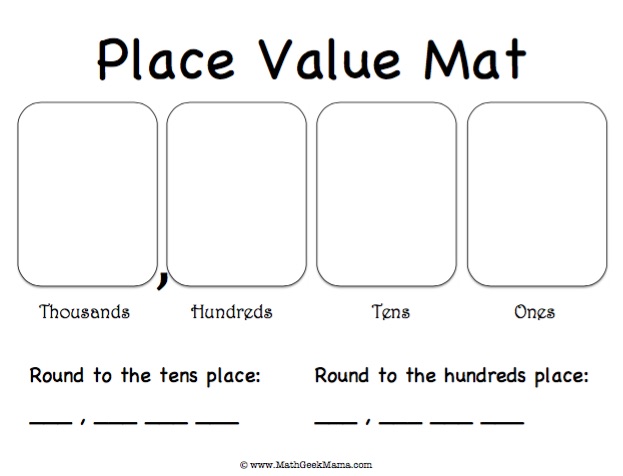
- printouts: place value charts, different graph templates (bar, circle, etc.)
There are tons of things around the house you can use to do different math activities. These are just some ideas.
Below are some specific games to try with household items. Enjoy!
Simon Says, “Geometry!”
Ramp up this traditional game by having kids illustrate the following geometric terms using only their arms: parallel and perpendicular lines; acute, right, and obtuse angles; and 0-, 90-, and 180-degree angles.
Challenge: Increase the pace of the commands and see if your students can keep up!
Adaptation: they can draw them, or have a bowl of pieces of paper that each have a term on it (square, circle, or more advanced/older kids try rhombus, obtuse angle, etc.) they pick a paper from the bowl and then draw the answer.
Ramp up this traditional game by having kids illustrate the following geometric terms using only their arms: parallel and perpendicular lines; acute, right, and obtuse angles; and 0-, 90-, and 180-degree angles.
Challenge: Increase the pace of the commands and see if your students can keep up!
Adaptation: they can draw them, or have a bowl of pieces of paper that each have a term on it (square, circle, or more advanced/older kids try rhombus, obtuse angle, etc.) they pick a paper from the bowl and then draw the answer.
Cover a beach ball with numbers (use a permanent marker or sticky labels). Toss the ball to one student and have her call out the number that her right thumb touches. She tosses it to the next student, who does the same and then adds his number to the first. Continue for five minutes and record the sum. Each time you play the game, add the sum to a graph. On which day did you reach the highest sum? The lowest?
Challenge: Use fractions, decimals, or a mix of negative and positive integers.
Adaptation: roll dice and do the same, flip a coin, etc.
Straw Poll
Ask a question and let students vote by placing a straw in one of several plastic cups, each labeled with a different answer. Later, younger students can graph the results, while older kids calculate the ratio and percentage for each response.
Challenge: If the entire school body was polled, and assuming each response got the same percentage of votes, how many votes would there be in each cup? What if your town was polled?
Adaptation: Have the child interview or survey the whole family or post or call family to survey them for questions to graph. What is your favourite pizza topping? How many places have you travelled to? Which places have you travelled to? etc. etc.
Sweet Math
Model this activity with one package of Skittles or M&Ms and a document camera, or let each student have his or her own package. Younger students can graph the contents of their packages by color. Older students can calculate the ratio of each color compared with the total number of pieces of candy in their packages.
Challenge: Compile the class results into one graph, then have each student compare his or her ratio to the ratio for the entire class.
Adaptation: use any food or fun item
Hopscotch Math
Set up a hopscotch grid with a calculator layout. With older kids, you can include the square root symbol and negative integer sign. Students first hop on one number, then an operation, another number, the equal sign, and finally the answer. For double-digit answers, students can split their last hop so that their left foot lands on the digit in the 10s place and their right foot lands on the digit in the ones place.
Challenge: The student taking a turn tosses a stone onto a number and must avoid that number in the equation.
Adaptations: Chalk this outside
It’s in the Cards
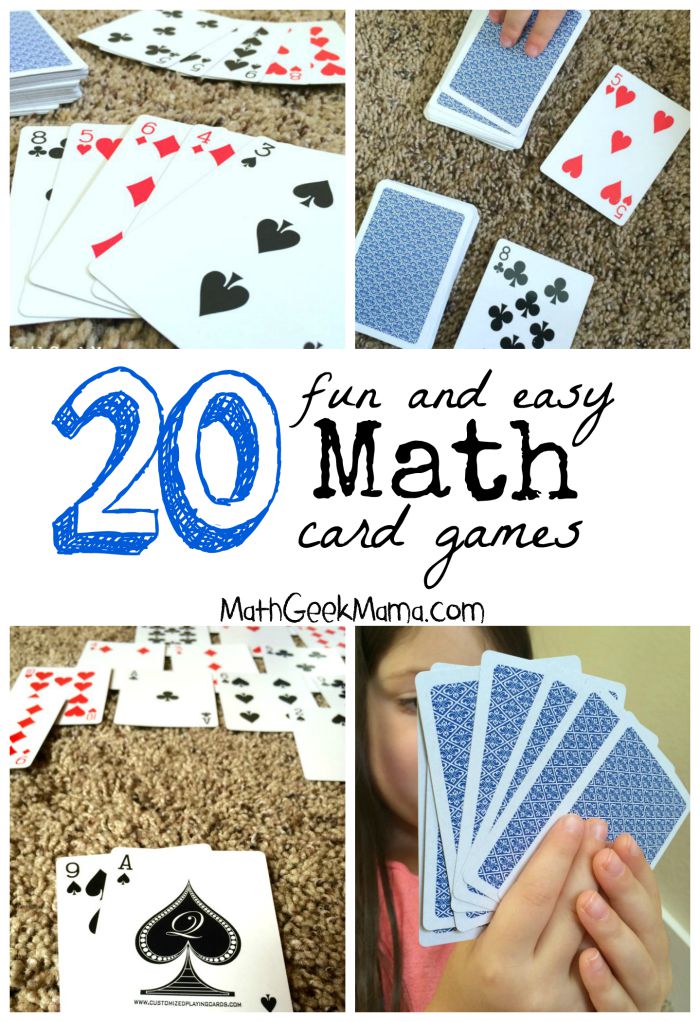
For a twist on the traditional card game War, assign values of 1 to the ace, 11 to the jack, 12 to the queen, and 13 to the king, and face value for the cards two through 10 (for younger children, limit the game to number cards only). Playing in pairs, each student lays two cards face up, then subtracts the lower number from the higher. Whoever has the higher answer wins all four cards. If the totals are the same, the players flip over two more cards and repeat until there is a winner.
Challenge: Use the two cards to form a fraction, and then compare to see who has the larger fraction. If they are equivalent, repeat until someone wins the round.
Adaptation: See my card math game post from a few weeks ago for some more ideas
Weighing In
Line up a variety of fruits and veggies, such as oranges, bananas, cucumbers, kiwis, tomatoes, and bell peppers. Ask students to predict the order of the foods from lightest to heaviest. Use a balance scale to test their predictions, then rearrange the foods according to their actual weights.
Challenge: Slice each fruit in half. Invite students to analyze how the density of the fruit or vegetable affects its weight.
**If you have a home scale this can be so fun! Endless possibilities.
Source: https://www.scholastic.com/teachers/articles/teaching-content/15-math-games-15-minutes-or-less/