Opinions expressed on this blog are my own and do not represent any other organization or affiliation I may have.
Showing posts with label lit circle. Show all posts

Sunday, 13 December 2015

Lit Circles - Great blog post with some new ideas to try


I love doing lit circles and have done them in a number of grades and schools, adapting over time to what I find to be a perfect set up now, though with every new class comes new ideas.

Even still, I am always finding new and innovative ways to improve lit circles and try new things and that is what this post is about, sharing some of those ideas.

This is taken from this blog post which you should check out.

Background

I divided my 29 students into six groups, and the students were allowed to decide with whom they worked. Throughout the year, each group read chapter books of their choosing, one after the other. All of the paperless work was completed in Schoology, our learning management system (LMS).
The students met for literature circles twice a week -- Mondays and Fridays -- for about 40 minutes per session. Here's what happened on each of those days.

Mondays

All six groups met, with four in the classroom and two in the hallway. After the groups came together, students confirmed their jobs for the week, which had to be completed by Friday. There were eight job descriptions:
  • Connector: Go into detail regarding a specific text-to-self or text-to-text connection.
  • Passage Picker: Find one or two paragraphs that are moving in some way. Write why you picked each passage and describe your thoughts.
  • Plot Twister: What exactly would you change in the chapters that you read for homework to make them go the way that you would have preferred? Why?
  • Wonderer: As you read, create a list of relevant statements starting with "What if?" or "I wonder."
  • Predictor: Based on what you read for homework, explain what you think is going to happen next. Also explain why you made your predictions.
  • Psychologist: Give advice to one of the book’s characters. What would you tell him or her to do, and why?
  • Journalist: Pick a character and, based on what you read for homework, write a passage in his or her personal journal.
  • Student Choice: Decide how you would like to respond to the chapters that you read for homework. If you aren't satisfied with any of the jobs, create your own idea.
Here are the directions that accompanied every job:
  1. Your homework (at least 6-8 sentences) should be posted to your Literature Circle group as a new discussion.
  2. Name the discussion "Job title, pages." (e.g. Connector, 1-52)
  3. For extra credit, attach a completed Role Sheet to your discussion. (The Role Sheets were from Literature Circle Role Sheets for Fiction and Nonfiction Books and Literature Circles: The Way to Go and How to Get There.)
  4. Quality comment on the discussions of others. Post your discussion early to leave time for others to comment.
After the students confirmed their jobs, they started their reading for the week, which consisted of about 40 pages from their book. They read with each other's jobs in mind, as they were encouraged to continually pause, discuss the book through the lens of their individual tasks, and take notes on what they learned from classmates.

Fridays

Students met to discuss the week's reading through their Schoology discussion forum posts (and optionally the role sheets). However, on a weekly basis, before everyone separated into groups, we investigated as a class how their posts could be used as conversation starters, but not as the conversation itself. As Stephanie Harvey and Harvey Daniels explain, when used improperly "these role sheets quickly become mechanical, hindering rather than empowering lively, spontaneous book talk" (p. 248).
To promote in-depth conversation, we were constantly coming up with sentence starters that would assist in uncovering a deeper understanding of what was read through rich inquiry and debate. (As a starting point, we called upon prompts from Integrating Differentiated Instruction and Understanding by Design and Embedded Formative Assessment.) In the end, the goal was for students to collaborate through the use of their own "thick" questions and without assistance from the teacher, outside resources, jobs, or role sheets.
During both the Monday and Friday sessions, I simply traveled from group to group, helping them to stay on task and facilitate conversation. As the school year progressed, the majority of the groups no longer needed my assistance.
During each Friday session I let all of the groups know when five minutes remained. At that point, the students individually completed and handed in either the Individual Rating Report (adapted from the Literature Circles book) or the Progress-Process Person form (adapted from the Literature Circle Role Sheets book). We alternated which handout was used on a weekly basis.
On the Individual Rating Report, students graded themselves on a scale for such statements as:
  • I was responsible and brought my book to class.
  • I encouraged others to share group work.
  • I shared group time by building on the ideas of others.
There were also a few open-ended questions involving what was learned, what questions existed, and what could be improved upon for next time.
On the Progress-Process Person form, students rated all of their group members on a scale regarding whether or not they were prepared, how much they contributed while also encouraging others to contribute, and if they remained focused.

In the End

My process represents one of countless ways to facilitate literature circles, so feel free to take it, argue with it, or adapt it to fit your students' needs.
If I were to return to the classroom and revise this process, it would be interesting do away with the jobs and role sheets altogether and have the students "take full responsibility for capturing their during-reading responses using Post-its, text annotations, bookmarks, and journals" (Harvey & Daniels, 2015).
How do you or could you run literature circles in your classroom? Could literature circles work across all content areas, and not just language arts?

Source:http://www.edutopia.org/blog/almost-paperless-literature-circles-ross-cooper

Wednesday, 16 April 2014

Novel Reading: Post-It Note Tumblr Class activity


imageimageimage  I absolutely LOVE this activity. I have tried similar strategies, but this teacher describes in detail the process and outcome - I love it!

In this class, students read the John Green novel of their choice.  We didn’t attempt to balance the groups. Because it was enrichment, we really wanted students to have choice and to read the novels that spoke to them.  We had about 35 students read The Fault in Our Stars.  We had just 6 students readWill Grayson, Will Grayson.  The rest of the students were scattered about equally between Paper Towns, Looking for Alaska, and An Abundance of Katherines.    
Our Goals
1) Students read independently. 2) Students come prepared to engage in text-based discussions. 3) Students write analytically about the text.
The strategy we introduced on the first day was a way of cataloging their Post-It notes during their reading.  We knew students would find a great number of passages in their reading that they found meaningful, but I wanted to push them to think more about why they passages they marked were significant.  (In previous Breakfast Club sessions, we’d found students didn’t want to annotate IN THEIR BOOKS.  For many of our kids, this was the first new book they’d ever owned and they were reluctant to write in them!)
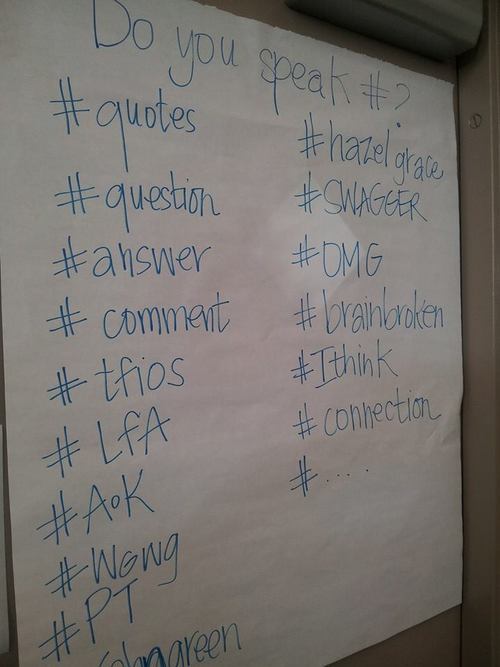
Our students loved to highlight their favorite passages by copying them onto Post-Its.  We asked them to tag those significant passages #quotes.  We also asked them to consider other hashtags, like #characterization, #plot, and #figlang.  Students were also encouraged to write their questions and reactions on Post-Its and to tag them accordingly.  From the first week, students were excited.
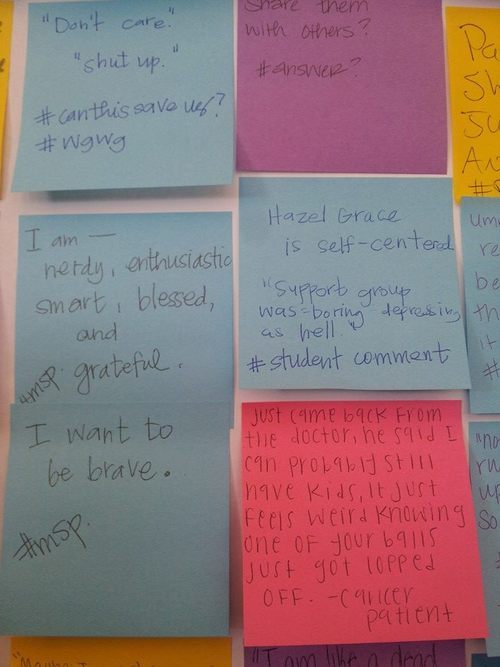
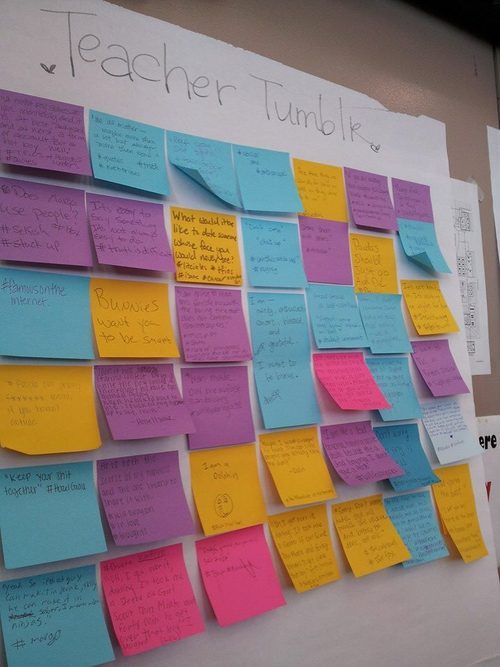
Every student had a large piece of construction paper where they were able to arrange their Post-Its each week.  We used them for first check ins.  Students would read the “Tumblrs” of their group mates.  We encouraged them to “like” and “comment” on each other’s Post-Its.  They were also able to “reblog” other student’s thoughts if they wanted to add to them.  (We made sure they gave their classmates credit.)  We also had a “Teacher Tumblr”. We used this to keep track of comments we heard when listening to the group discussions and questions that came up for us.  We also invited students to add questions and comments, which they did.  With enthusiasm.
Integrating Evidence Meaningfully in Discussion and Writing
One way we used the Post-It Notes to help students get ready to speak and write about their texts was to ask them to pull out those Post-Its on which they’d written significant lines or passages from the text.  We knew our students could read and opine about the action and the characters, but they struggled to present substantial evidence to support their assertions.  Their first instincts were not to begin with the text and work out from there.  Often we’d receive writing assignments that included NO evidence from the text.  In revision, students would go back to the text looking for three or four quotes to shove into the already-written essay.  Not a lot of commentary there.  
So we asked students to pull out those quotes, and then on new Post-Its, we asked them to write a sentence or two of context.  What’s happening in the quote or passage?  What would a reader need to know?  #context Now, get another Post-It.  What does it mean?  What is the writer doing? Why is it significant to the greater meaning of the text? #commentary
Students began to understand the ways they could be commenting on the text, and they began making these notes independently as they were reading.  
It was powerful because when we asked students to come together and discuss questions about their text, they were ready to talk.  They had things to say.  They went to their Post-It Notes and some of the processing had already begun.  
The flexibility and mobility of the Post-Its also helped our students to track the development of characters and themes across the text.  They could group patterns together, they could look at statements characters made early in the text side by side with statements they’d made later in the text. 
We introduced “The Author Says, I Say” to help students see how to seamlessly integrate evidence into their own writing. 
On the last day, when we gave the students an unannounced on-demand writing assignment, you could hear a pin drop in the room.  Students who used to struggle to write a sentence had something to say.  In all the weeks leading up to the last class, we never told the students they would be expected to write, but when we asked them to, they were ready, because they had already had multiple opportunities to process their thinking, and discuss and write about the text.
Our students reported feeling more confident as readers and writers and during the debrief, they talked about ways they could use the strategies in other classes.


Source