Opinions expressed on this blog are my own and do not represent any other organization or affiliation I may have.
Showing posts with label lesson. Show all posts

Monday, 13 April 2015

KABOOM - Great Learning Game for Classrooms

I just found this game online and am obsessed! I can't wait to create a few versions of this activity for my classes!

WHY?


1. It is highly engaging!
2. It lasts for as long as you need it to!
3. It can accommodate nearly ANY content area/targeted skill!
4. It is quick to prep!
5. It costs next to nothing to make!


You need sticks, a cup/holder, and to determine which subject area you want to focus on.

For example - basic math facts:


Or maybe you need to glue on some items:


or labels/tags:


You can do this for vocab, definitions, math equations, sight words, rounding, parts of speech, synonyms, antonyms, story elements, the options are endless!


Once you decide and create - here is how to play...


1.  First student pulls out a popsicle stick.
2.  The student identifies the "answer" or "correct response."  If their answer is correct (determined by either a reference sheet or their peers) they get to keep the popsicle stick.  If they answer it incorrectly, the stick must go back in the cup.
3.  The students continue around the circle, selecting one popsicle stick at a time and answering their question.
4.  Any student who pulls a KABOOM! stick has to place all of the popsicle sticks they have accumulated back into the cup, leaving them with zero.  (It may sound harsh, but it happens OFTEN, so all students will at some point get "Kaboomed!"
5.  The game NEVER ENDS because eventually someone will get a Kaboom! and their popsicle sticks will go back into the cup to keep the game going.
 
Source: http://www.starrspangledplanner.com/2015/03/kaboom-possibly-best-center-game-ever.html

Sunday, 12 April 2015

Parts of a Plant - Labeling Parts

A Simple Plant Project {labeling parts}

  After learning about the different parts of a plant, students put their knowledge to good use with this art project.


Here's what we used:  blue construction paper for the background, 1/3 brown construction paper for the soil, snippets of brown yarn for the roots, half of a green pipe cleaner for the stem, free-drawn leaves on green felt, bold colored cupcake liners for the flowers, sunflower seeds for the center of the flower.

After assembling their plant, students cut and paste these labels to complete their project.  Grab the labels here if you can use them!

https://drive.google.com/file/d/0BwW7vuV_FLG-cDZyVzcwVEExVTQ/view?usp=sharing


Thanks to Mrs. Lirettes Learning Detectives Blog for this awesome idea!

Monday, 24 November 2014

Powerful Lesson on Privilege - buzzfeed

This resonated with me:


I once saw a high school teacher lead a simple, powerful exercise to teach his class about privilege and social mobility. He started by giving each student a scrap piece of paper and asked them to crumple it up.

I once saw a high school teacher lead a simple, powerful exercise to teach his class about privilege and social mobility. He started by giving each student a scrap piece of paper and asked them to crumple it up.
Nathan W. Pyle / Via buzzfeed.com

Then he moved the recycling bin to the front of the room.

Then he moved the recycling bin to the front of the room.
Nathan W. Pyle / Via buzzfeed.com

He said, “The game is simple — you all represent the country’s population. And everyone in the country has a chance to become wealthy and move into the upper class.”

He said, "The game is simple — you all represent the country's population. And everyone in the country has a chance to become wealthy and move into the upper class."
Nathan W. Pyle / Via buzzfeed.com

“To move into the upper class, all you must do is throw your wadded-up paper into the bin while sitting in your seat.”

"To move into the upper class, all you must do is throw your wadded-up paper into the bin while sitting in your seat."
Nathan W. Pyle / Via buzzfeed.com

The students in the back of the room immediately piped up, “This is unfair!” They could see the rows of students in front of them had a much better chance.

The students in the back of the room immediately piped up, "This is unfair!" They could see the rows of students in front of them had a much better chance.
Nathan W. Pyle / Via buzzfeed.com

Everyone took their shots, and — as expected — most of the students in the front made it (but not all) and only a few students in the back of the room made it.

Everyone took their shots, and — as expected — most of the students in the front made it (but not all) and only a few students in the back of the room made it.
Nathan W. Pyle / Via buzzfeed.com

He concluded by saying, “The closer you were to the recycling bin, the better your odds. This is what privilege looks like. Did you notice how the only ones who complained about fairness were in the back of the room?”

He concluded by saying, "The closer you were to the recycling bin, the better your odds. This is what privilege looks like. Did you notice how the only ones who complained about fairness were in the back of the room?"
Nathan W. Pyle / Via buzzfeed.com

“By contrast, people in the front of the room were less likely to be aware of the privilege they were born into. All they can see is 10 feet between them and their goal.”

"By contrast, people in the front of the room were less likely to be aware of the privilege they were born into. All they can see is 10 feet between them and their goal."
Nathan W. Pyle / Via buzzfeed.com

“Your job — as students who are receiving an education — is to be aware of your privilege. And use this particular privilege called “education” to do your best to achieve great things, all the while advocating for those in the rows behind you.”


Source

Wednesday, 1 October 2014

Making Ten


Have students work in pairs. Each student has ten cubes of one color and a blank copy of the chart. Each pair trades one color cube with partner and colors in our chart to match. Fantastic to reach all learners: oral, visual, kinethetic, tactile.

Source: http://owl.li/C2Jzr

Tuesday, 3 June 2014

Foldable Writing Projects

INTERACTIVE READING NOTEBOOKS INFORMATIONAL TEXT: NONFICTION FOR COMMON CORE 4-8 - TeachersPayTeachers.com

This is from pinterest and links to a teachers pay teachers site where you can purchase the book, but I just liked the photo as it shows some cool foldable writing assignments.

I have done foldables assignments with the Canada Food Guide in Home Ec this year with grade 6/7s, as well as with flour mixtures for my Grade 8s. They made pyramids, cubes, all with foldable parts to give details about different topics. Love it!


Source

Wednesday, 16 April 2014

Novel Reading: Post-It Note Tumblr Class activity


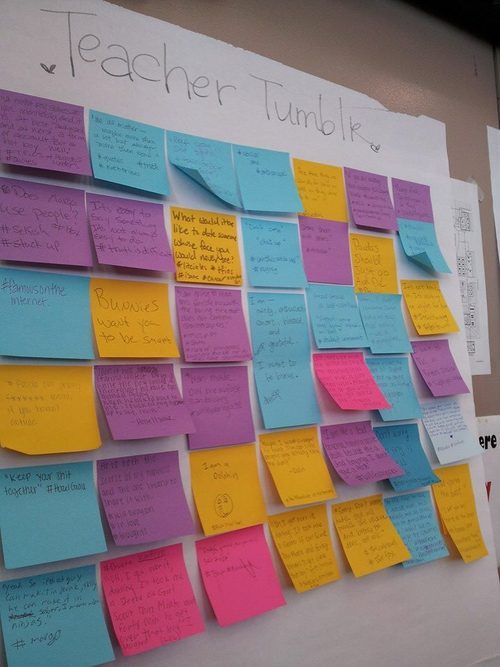
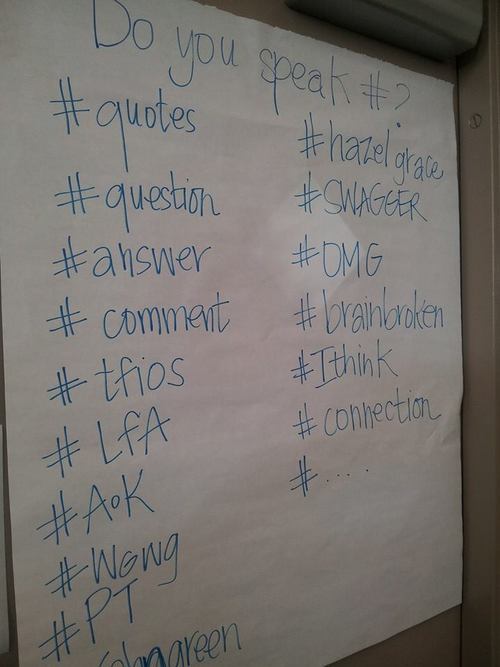
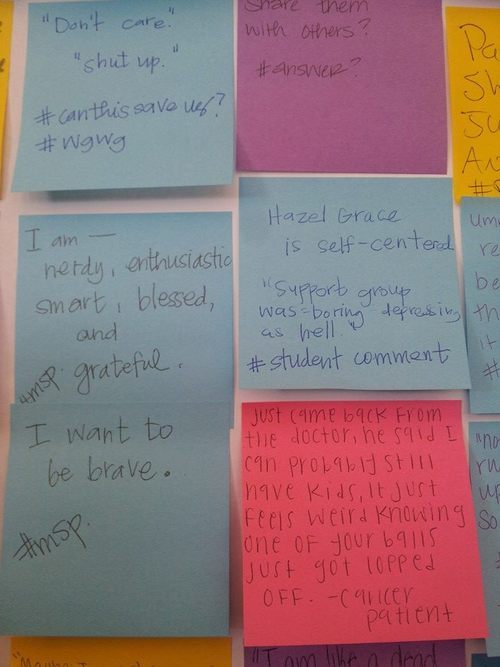
imageimageimage  I absolutely LOVE this activity. I have tried similar strategies, but this teacher describes in detail the process and outcome - I love it!

In this class, students read the John Green novel of their choice.  We didn’t attempt to balance the groups. Because it was enrichment, we really wanted students to have choice and to read the novels that spoke to them.  We had about 35 students read The Fault in Our Stars.  We had just 6 students readWill Grayson, Will Grayson.  The rest of the students were scattered about equally between Paper Towns, Looking for Alaska, and An Abundance of Katherines.    
Our Goals
1) Students read independently. 2) Students come prepared to engage in text-based discussions. 3) Students write analytically about the text.
The strategy we introduced on the first day was a way of cataloging their Post-It notes during their reading.  We knew students would find a great number of passages in their reading that they found meaningful, but I wanted to push them to think more about why they passages they marked were significant.  (In previous Breakfast Club sessions, we’d found students didn’t want to annotate IN THEIR BOOKS.  For many of our kids, this was the first new book they’d ever owned and they were reluctant to write in them!)
Our students loved to highlight their favorite passages by copying them onto Post-Its.  We asked them to tag those significant passages #quotes.  We also asked them to consider other hashtags, like #characterization, #plot, and #figlang.  Students were also encouraged to write their questions and reactions on Post-Its and to tag them accordingly.  From the first week, students were excited.
Every student had a large piece of construction paper where they were able to arrange their Post-Its each week.  We used them for first check ins.  Students would read the “Tumblrs” of their group mates.  We encouraged them to “like” and “comment” on each other’s Post-Its.  They were also able to “reblog” other student’s thoughts if they wanted to add to them.  (We made sure they gave their classmates credit.)  We also had a “Teacher Tumblr”. We used this to keep track of comments we heard when listening to the group discussions and questions that came up for us.  We also invited students to add questions and comments, which they did.  With enthusiasm.
Integrating Evidence Meaningfully in Discussion and Writing
One way we used the Post-It Notes to help students get ready to speak and write about their texts was to ask them to pull out those Post-Its on which they’d written significant lines or passages from the text.  We knew our students could read and opine about the action and the characters, but they struggled to present substantial evidence to support their assertions.  Their first instincts were not to begin with the text and work out from there.  Often we’d receive writing assignments that included NO evidence from the text.  In revision, students would go back to the text looking for three or four quotes to shove into the already-written essay.  Not a lot of commentary there.  
So we asked students to pull out those quotes, and then on new Post-Its, we asked them to write a sentence or two of context.  What’s happening in the quote or passage?  What would a reader need to know?  #context Now, get another Post-It.  What does it mean?  What is the writer doing? Why is it significant to the greater meaning of the text? #commentary
Students began to understand the ways they could be commenting on the text, and they began making these notes independently as they were reading.  
It was powerful because when we asked students to come together and discuss questions about their text, they were ready to talk.  They had things to say.  They went to their Post-It Notes and some of the processing had already begun.  
The flexibility and mobility of the Post-Its also helped our students to track the development of characters and themes across the text.  They could group patterns together, they could look at statements characters made early in the text side by side with statements they’d made later in the text. 
We introduced “The Author Says, I Say” to help students see how to seamlessly integrate evidence into their own writing. 
On the last day, when we gave the students an unannounced on-demand writing assignment, you could hear a pin drop in the room.  Students who used to struggle to write a sentence had something to say.  In all the weeks leading up to the last class, we never told the students they would be expected to write, but when we asked them to, they were ready, because they had already had multiple opportunities to process their thinking, and discuss and write about the text.
Our students reported feeling more confident as readers and writers and during the debrief, they talked about ways they could use the strategies in other classes.


Source