Opinions expressed on this blog are my own and do not represent any other organization or affiliation I may have.
Showing posts with label high school. Show all posts

Wednesday, 16 April 2014

Novel Reading: Post-It Note Tumblr Class activity


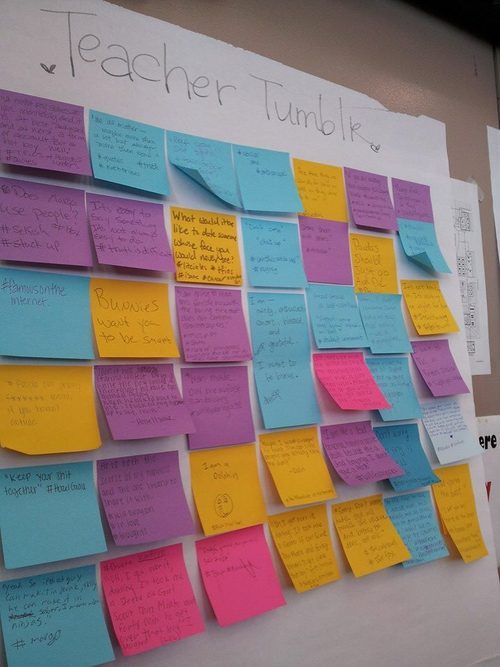
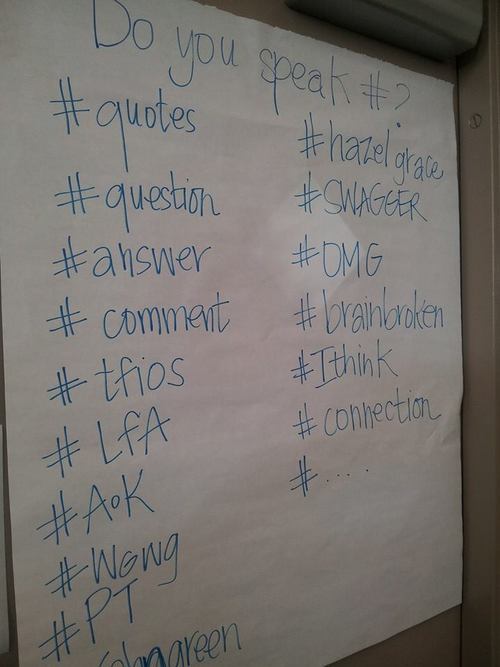
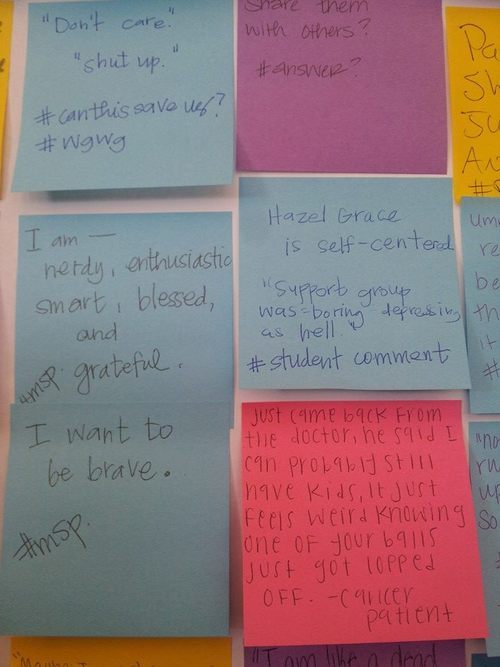
imageimageimage  I absolutely LOVE this activity. I have tried similar strategies, but this teacher describes in detail the process and outcome - I love it!

In this class, students read the John Green novel of their choice.  We didn’t attempt to balance the groups. Because it was enrichment, we really wanted students to have choice and to read the novels that spoke to them.  We had about 35 students read The Fault in Our Stars.  We had just 6 students readWill Grayson, Will Grayson.  The rest of the students were scattered about equally between Paper Towns, Looking for Alaska, and An Abundance of Katherines.    
Our Goals
1) Students read independently. 2) Students come prepared to engage in text-based discussions. 3) Students write analytically about the text.
The strategy we introduced on the first day was a way of cataloging their Post-It notes during their reading.  We knew students would find a great number of passages in their reading that they found meaningful, but I wanted to push them to think more about why they passages they marked were significant.  (In previous Breakfast Club sessions, we’d found students didn’t want to annotate IN THEIR BOOKS.  For many of our kids, this was the first new book they’d ever owned and they were reluctant to write in them!)
Our students loved to highlight their favorite passages by copying them onto Post-Its.  We asked them to tag those significant passages #quotes.  We also asked them to consider other hashtags, like #characterization, #plot, and #figlang.  Students were also encouraged to write their questions and reactions on Post-Its and to tag them accordingly.  From the first week, students were excited.
Every student had a large piece of construction paper where they were able to arrange their Post-Its each week.  We used them for first check ins.  Students would read the “Tumblrs” of their group mates.  We encouraged them to “like” and “comment” on each other’s Post-Its.  They were also able to “reblog” other student’s thoughts if they wanted to add to them.  (We made sure they gave their classmates credit.)  We also had a “Teacher Tumblr”. We used this to keep track of comments we heard when listening to the group discussions and questions that came up for us.  We also invited students to add questions and comments, which they did.  With enthusiasm.
Integrating Evidence Meaningfully in Discussion and Writing
One way we used the Post-It Notes to help students get ready to speak and write about their texts was to ask them to pull out those Post-Its on which they’d written significant lines or passages from the text.  We knew our students could read and opine about the action and the characters, but they struggled to present substantial evidence to support their assertions.  Their first instincts were not to begin with the text and work out from there.  Often we’d receive writing assignments that included NO evidence from the text.  In revision, students would go back to the text looking for three or four quotes to shove into the already-written essay.  Not a lot of commentary there.  
So we asked students to pull out those quotes, and then on new Post-Its, we asked them to write a sentence or two of context.  What’s happening in the quote or passage?  What would a reader need to know?  #context Now, get another Post-It.  What does it mean?  What is the writer doing? Why is it significant to the greater meaning of the text? #commentary
Students began to understand the ways they could be commenting on the text, and they began making these notes independently as they were reading.  
It was powerful because when we asked students to come together and discuss questions about their text, they were ready to talk.  They had things to say.  They went to their Post-It Notes and some of the processing had already begun.  
The flexibility and mobility of the Post-Its also helped our students to track the development of characters and themes across the text.  They could group patterns together, they could look at statements characters made early in the text side by side with statements they’d made later in the text. 
We introduced “The Author Says, I Say” to help students see how to seamlessly integrate evidence into their own writing. 
On the last day, when we gave the students an unannounced on-demand writing assignment, you could hear a pin drop in the room.  Students who used to struggle to write a sentence had something to say.  In all the weeks leading up to the last class, we never told the students they would be expected to write, but when we asked them to, they were ready, because they had already had multiple opportunities to process their thinking, and discuss and write about the text.
Our students reported feeling more confident as readers and writers and during the debrief, they talked about ways they could use the strategies in other classes.


Source

Tuesday, 8 April 2014

Teacher responds to profane letter but proofreading the letter with red pen....

A student wrote this letter to their teacher, who proceeded to edit it like any submitted written work in an English class. Pretty nicely done, though I wouldn't leave the end comment about "looking stupid"

The teacher went through and sliced and diced the letter in red marker, noting everything from not having a date to not indenting the signature line to a comma splice.

See the letter below. Note: Some readers might find some of the language offensive.

fixletter

Source: WGNTV and Reddit

Friday, 21 March 2014

Article: To Keep Teenagers Alert, Schools Let Them Sleep In

Jilly Dos Santos organized an effort to push back her high school’s start time to 9 a.m.


COLUMBIA, Mo. – Jilly Dos Santos really did try to get to school on time. She set three successive alarms on her phone. Skipped breakfast. Hastily applied makeup while her fuming father drove. But last year she rarely made it into the frantic scrum at the doors of Rock Bridge High School here by the first bell, at 7:50 a.m.
Then she heard that the school board was about to make the day start even earlier, at 7:20 a.m.
“I thought, if that happens, I will die,” recalled Jilly, 17. “I will drop out of school!”
That was when the sleep-deprived teenager turned into a sleep activist. She was determined to convince the board of a truth she knew in the core of her tired, lanky body: Teenagers are developmentally driven to be late to bed, late to rise. Could the board realign the first bell with that biological reality?
The sputtering, nearly 20-year movement to start high schools later has recently gained momentum in communities like this one, as hundreds of schools in dozens of districts across the country have bowed to the accumulating research on the adolescent body clock.
In just the last two years, high schools in Long Beach, Calif.; Stillwater, Okla.; Decatur, Ga.;, and Glens Falls, N.Y., have pushed back their first bells, joining early adopters in Connecticut, North Carolina, Kentucky and Minnesota. The Seattle school board will vote this month on whether to pursue the issue. The superintendent of Montgomery County, Md., supports the shift, and the school board for Fairfax County, Va., is working with consultants to develop options for starts after 8 a.m. 
Continue Reading

When I was a teenager, I remember reading research that said teens needed more sleep and learned better late morning and afternoon. Of course, I wished that schools would adapt to this schedule and we could sleep in and go to school later.

I would have enjoyed a 10am-4pm day in high school, but we had an 8am start.


Read More Here

Monday, 27 May 2013

Message to grade eights from High schoolers - cute video!

I really love this video... the highschool leadership students created this for the grade eights who will be coming to their school next year:

Wednesday, 13 June 2012

Macbeth Rap

My friend and colleague did Macbeth with her English class and as a final project a group of students presented this video.... It is amazing!

Wednesday, 6 June 2012

Zero Grade

 How do you feel about issuing "zero" grades on assignments? This is an interesting discussion I have been reading a lot about lately.

Minister of Education in Alberta has said that zero is a last resort only. After an Edmonton teacher was suspended for issuing students zero.

Lynden Dorval, an Edmonton Science teacher was suspended after issuing students a zero grade for assignments not handed in.

The physics teacher with 35 years experience said he continued giving zeros when students failed to hand in assignments, instead of using behaviour codes such as "not completed," which the school requires under its grading and reporting practice.
...
In Dorval's physics and science classes at Ross Sheppard High School, students who didn't turn in assignments got a printout of their marks showing them how a zero would affect their overall grade. Most times, the strategy spurred students to complete the work, he said.
This got me thinking... In the high school english class I am currently teaching, I plug in an "NHI" (Not handed in) for assignments missing. This is practice continued from the previous teacher as I am in for the last month of school.

Students get a print out of what is missing and an opportunity to hand them in. I believe in giving students an opportunity to make up missed work since some have not handed things in due to absence, illness, and so on, and to be honest, some are just being lazy or avoiding work. Either way, they are given adequate time to catch-up, make up and ensure they have submitted all assignments for a grade that reflects all their work.

But, I am in a temporary contract with one English class and one Student Services block.

I wonder, how a teacher with 4 english classes per semester, over 100 students, may handle a wave of late assignments at the end of a semester while marking end of term exams, essays and projects.

What is the purpose of a deadline? How important is formal grading? How much control do we really have over assessment and grading in high school, particularily Grade 11 and 12 as many students prepare for post-secondary education.

Giving a student a zero teaches them a lesson  talks about alternative motivation and argues against giving a zero to students. It is an interesting read.

What I enjoyed about this post most were the comments. The discussion.

One talked about the fact that, until Universities stopped using grades as criteria for entrance, we can't stop using them in high school.

Another comment talks about class size and how a high school teacher can adequately give the individual attention needed with 4 full classes and over 100 students a semester.

I taught in Middle School where I used a 4 point scale for most assignments. Final grades were converted to a letter grade, but we did not focus on percentages or grades the same way high schools do. I used comments and ongoing assessment and communication to work with students on goal setting and improving.

Now, teaching in high school, it is all about the grade. Students are obsessed!

Not a single day goes by without at least one students asking me what their grade is so far.

Nevermind that somethings are not marked, or entered into the system yet, nevermind that provincial exams and finals or huge parts of their grade is not yet input, they want to know their percentage at that moment. Every moment!

Why?

Because the focus has become the grade.

As parents, we focus on the grade as well. I told myself I wouldn't, but when my daughter brings home her report card, I inadvertently look at the grades first.

I really enjoyed the Job Action this year, because there were no report cards, instead, communication, discussion, between teachers and parents on how a student was progressing. Without the letter or percentage to occupy all the attention, the details, the study habits, the OTHER parts of assessment were more important.

Have you ever seen a student with an A but an N work habit grade? What about a C- but a G work habit grade? Which would you rather see?

Far too often the letter grade is given more weight.

I enjoy professional conversation on this topic and others. I am curious what others think and what they use for their teaching practice.

Monday, 28 May 2012

Questions Students Ask Teachers-On-Call

I read a great post over at Sub Hub about questions TTOCs get from students. The questions are the same as the ones I hear day to day but my answers are a little bit different....
No matter if I am subbing for an afternoon, a whole day, or an extended stay, not a day goes by that I don't hear these questions. I have gotten to where I have some fairly standard responses to them.
1. Where is Ms. So-and-So?
I usually say, "I am not sure, but they should be back tomorrow (or whenever I am scheduled until, if I don't know I say "soon") Sometimes it is fun to use a silly response. Here are some I read on another blog:
She's visiting Candyland today; she's spending the whole day doing nothing but eating cotton candy; she's auditioning for American Idol... anything crazily outlandish, and the sillier the better. Sometimes the students even get a kick out of trying to figure out if I am kidding or not.
2. What time is recess/lunch/specials?Usually I tell them how long, but I like this response:
It doesn't seem to matter whether it's kindergarten or fifth grade, someone always asks about times for standard parts of the schedule. In that case, I always have the same response. "It's the same time it's been all year." I know, it's sarcastic. But I always follow it up with a correct response.
3. Is this for a grade?I always tell them that their teacher asked me to collect it, so I would guess it is for marks. This is because if it isn't for marks, they tend to not put forth any effort.

4. Can we use markers? (or some toy, game, book)I ALWAYS say, "what is the usual rule?" Generally I try to stick to the regular classroom rules, if they aren't sure if they are usually allowed, I say no. Here is the subhub's response to this question:
Oh my, how those elementary kiddos love their markers! It makes them positively giddy if you say yes to that question. If it's something I know is a graded assignment, I ask what the normal rule is in the classroom. If it's something I know is enrichment or extra practice, I might say yes just to make them happy.
5. Can we work in partners/groups?
Depending on the class, I usually say yes, but that if it becomes too loud/off task/disruptive, the privilege is lost.
I also hear this a lot:

Ms. So-and-so does this....
I often look around and ask if I look like Ms. so-and-so... with younger children I usually start my day letting them know that while I love to learn how they do (this and that) in their classroom, that I go to a lot of different classrooms and I may do things a little bit different, just for today. Calendar time tends to be the thing most Primary classes need to be "exactly the same" every day, every teacher, no matter what.

I think it is important children learn to adapt to new faces and routines, but also to keep them feeling safe and comfortable. I try to have a helpful student run the show. Luckily, most primary classes have a "special friend" of the day who gets to run calendar and they usually know EXACTLY how it is done!

What questions do you hear often? How do you respond to those questions or any of these questions?

Sunday, 27 May 2012

Midsummer Night's Dream Facebook Assignment

So I decided to do fake facebook accounts with my Grade 9 Highschool Class for Midsummer Night's Dream. I saw "Shakesbook" and "Fakebook" assignments online and used them as inspiration to create this project. Students had 2 computer lab classes to complete the assignment and most finished easily in that time, while some needed to take extra time at home to finish.

Below I have posted the instructions, marking rubric and sources as well as some links to a few samples from my students.

Fakebook Profile for a Main Character
1. Choose one of the main characters.
2. Create a "fakebook" profile for the character that reflects what you know about them.
3. Write 5 status updates for the character that relate to major events in the plot and
    accurately reflect the characters personality.
4.Create 10 or more responses to the statuses from other characters.
5. You may have MORE posts if you wish.
6. Ensure the statuses are in reverse chronological order with most recent at the top.
7. Include your name and block at the bottom of the page.
8. Save a copy for your files and print a copy to turn in.
Marking Rubric

Minimum 5 Status Updates that reflect characters personalities and refer to major events in the
plot in chronological order. /5

Minimum 10 replies reflect characters personalities and relationships. /5

Profile details reflect character and show understanding of character. /5

Creative, correct formatting, appearance resembles template/examples. /5

Total:    /20

Resources

You may use any of the below resources to create your page or create your own as long as it
contains all the criteria:

1. Fakebook is an online ap. You can click to edit and create a page then save and print.
http://www.classtools.net/fb/home/page
2. Facebook template for Microsoft Word.
http://office.microsoft.com/en-ca/templates/facebook-template-word-TC102239159.aspx

3. I have several templates I will share with the class.

Samples

*Please note at the time of posting these links are active and accurate, but may become unactive or edited in the future without my knowledge. These are a random selection of examples.

Demetrius: http://www.classtools.net/fb/31/BCYd7a

Nick Bottom: http://www.classtools.net/fb/36/WUbGMA

Puck: http://www.classtools.net/fb/56/JegDDX

Hermia: http://www.classtools.net/fb/17/g8mU4D

Lysander: http://www.classtools.net/fb/35/hHdYTW

Nick Bottom: http://www.classtools.net/fb/25/hKJDeB

Helena: http://www.classtools.net/fb/74/BgUNgi

Helena: http://www.classtools.net/fb/67/3Ee2Ci

Twitter
Two students paired up to use twitter to create their own version of the project:

Helena: https://twitter.com/#!/helenalovesdem
Demetrius: https://twitter.com/#!/2cool4helena


Wednesday, 23 May 2012

Final Projects - Midsummer Night's Dream

I really enjoy giving students choices for final projects. I am in a temporary position until the end of the year and we are doing Grade 9 Midsummer Night's Dream. I believe final projects can be a great way to assess learning in a variety of ways. For my groups I have set-up their final project, which I will share in a future post, but for now, here is a list of ideas that helped motivate me to create some cool options for my class.....
1.
THE DAILY NEWS: Imagine you are an Athenian journalist who wants to report the events of A Midsummer Night’s Dream in your newspaper story. Apply the information given in the play to your story and design an appropriate layout for your newspaper.
2.
THE EVENING NEWS WITH ________________: Write a script for a news broadcast which reports on the events in A Midsummer Night’s Dream. Include a weather report, a missing person report, a fast-breaking story, a human-interest angle, a "strange but true" feature, etc. Use at least two anchors to present the broadcast. You may videotape or perform your broadcast for the class.
3.
A BUSY DAY AT THE CASTING AGENCY: A casting agency is where actors are selected to play parts in movies. Suppose you are the head of the largest casting agency in Hollywood, and a large film studio that wants to make a new movie version of A Midsummer Night’s Dream has contracted you. Make up the casting list by deciding which roles will go to which movie or television actors. Decide during what time period your production will take place. Also, write a short synopsis on why you think each actor is "perfect for the role."
4.
YOU’RE THE TALK SHOW HOST: Imagine yourself as a popular talk show host. Your producer tells you that next week you will have the characters of A Midsummer Night’s Dream on your show. As you plan your show, consider such things as the show’s title (for example, "Runaway Athenian Kids"), whom to have in the audience (Athenian teens, nobility, etc.), and your own angle on the story (Fairies and Sprites: can they be trusted?). Write a script, and act it out or videotape it for the class.
5.
COMIC BOOK CREATOR: If you have a natural talent to write a comic book, or you have ever wanted to try to write a comic book, try reproducing A Midsummer Night’s Dream as a comic. Remember that you must use the actual dialogue of the play in order to write your comic; you may edit the text, but you must use enough of the main story to keep the plot true to the story as told in the play.
6.
WANTED: Create a "wanted" poster for Puck, the mischievous sprite. You must include an illustrated "photo," a list of his criminal activities (mischief-making), physical description, aliases, where he was last seen, his probable whereabouts, and any rewards being offered. Who is offering the reward for his capture (think about who in the play might want to capture Puck to keep him from further mischief)? What punishment might he receive if he were captured?
7.
FLOWERS FOR SALE: Create a commercial and print ad campaign for Oberon’s magic flower, the "Love-in-idleness." You must come up with a pitch, a slogan, and one unique way to market your target audience. Who would be the most likely to buy such a product? What would be the best ways to reach this audience—radio, television, direct mail, billboards, magazines, newspapers, Internet ads? Would getting testimonials from several "satisfied customers" be effective? Create your campaign and present it to the class.
8.
FASHION DESIGNER: Fairy Wear is the latest fashion! Create sketches of clothes fit for Titania and Oberon, the Queen and King of the Fairies. Remember, they are the rulers of the natural world, so the clothing should have a "natural" appearance. Then, plan a fashion show to unveil these designs: write a descriptive plan of the show including the brand name, the theme of the show, music used during the show, a script for the host to use to describe the fashions, etc. Then videotape the fashion show using "live" models or dolls!
9.
WEDDING PLANNER: Imagine that you are in charge of the wedding of Theseus and Hippolyta. There is no limitation on the budget, so you have unlimited resources. What would you plan for the wedding ceremony? The wedding reception? Prepare a detailed schedule and a budget of the event.
10.
CHILDREN’S BOOK AUTHOR: Create a children’s story about the fairies in the play. They can interact with characters from the play or with new characters that you create. Keep in mind the personality of each fairy so that they act in ways that are true to their characters. Illustrate the book with your own drawings, pictures from magazines, or from pictures you design on a computer. Create a cover that displays the title of your book, a scene from the book, and your name. Find a creative way to bind the book together!

[Source]

Tuesday, 22 May 2012

Midsummer Night's Dream - 2 fun games

I have been seeking ways to do more engaging activities during our Midsummer Night's Dream unit. I found these awesome activities and although i was reluctant to try them with my chatty, mostly male, Grade 9 English class (last block of the day also!!!) I gave it a shot and was pleased with how into it they got (ok, they prizes helped motivate them) I was also super excited to discover how much they had retained from the play thus far!


A Midsummer Night’s Dream Scavenger Hunt

Part One:
Discover how your classmates’ opinions and experiences relate to the play! Walk around the room and find a student to which each statement applies and ask him/her to initial the square. Students may initial each paper only once! The first student to complete all 25 squares wins!! Share your findings with the class and discuss the situations to which you can relate and why.


___ has played a trick on somebody
Puck
___ has "loved" someone who didn’t return the feeling
___ has felt jealousy
___ has envied a friend’s good looks
___ has had parents disapprove of a relationship
___ has tried to run away from a problem
___ believes in love at first sight
___ has fought with a friend over a boy/girl
___ regrets falling in love with someone
___ has had funny or bizarre dreams recently
___ believes that looks don’t matter when in love
___ likes to tease or mock others
___ has disobeyed a parent
___ has been annoyed by a persistent admirer
___ has had a crush on the friend of a boyfriend/
girlfriend
___ enjoys magic shows or tricks
___ has gotten completely lost
___ is sometimes fickle about love
___ has told a friend’s secret
___ has been spoiled
___ enjoys plays and shows
___ has rudely insulted a friend
___ has refused a loved one’s demands
___ likes to play "matchmaker"
___ has performed on stage


Then on a BINGO sheet have students write out these names in random order:

Demetrius Hermia Oberon Snout

Egeus Hippolyta Peter Quince Snug

Francis Flute Lysander Philostrate Theseus

Helena Nick Bottom Puck Titania

Bingo Directions for Teachers: Use the following descriptions or quotes to test your students’ knowledge of the characters of A Midsummer Night’s Dream!

Descriptions:
1. wants to take the changeling child from the Fairy Queen (Oberon)
2. falls in love with a mortal while under the spell of a love potion (Titania)
3. the Duke of Athens (Theseus)
4. the Queen of the Amazons (Hippolyta)
5. says the "Prologue" of the play Pyramus and Thisby (Peter Quince)
6. plays the lead male role in the play Pyramus and Thisby (Nick Bottom)
7. plays the lead female role in the play Pyramus and Thisby (Francis Flute)
8. is worried about learning his lines for the play Pyramus and Thisby (Snug)
9. plays the Wall in the play Pyramus and Thisby (Snout)
10. asks the Duke to force his daughter to marry Demetrius (Egeus)
11. the man Helena loves (Demetrius)
12. the man Hermia loves (Lysander)
13. reveals her best friend’s secret to the man she loves (Helena)
14. puts a love potion in the wrong man’s eyes (Puck)
15. runs away with her lover against her father’s wishes (Hermia)
16. does not think the Duke will enjoy the play Pyramus and Thisby (Philostrate)

Quotes:
1. "The course of true love never did run smooth." (Lysander)
2. "Love looks not with the eyes, but with the mind, And therefore is winged Cupid painted blind." (Helena)
3. "Bless thee, Bottom! bless thee! thou art translated." (Peter Quince)
4. "I am that merry wanderer of the night." (Puck)
5. "The villain is much lighter-heeled than I. I followed fast, but faster did he fly." (Lysander)
6. "Yet marked I where the bolt of Cupid fell. It fell upon a little western flower, Before milk-white, now purple with love’s wound" (Oberon)
7. "I have had a dream, past the wit of man to say what dream it was. Man is but an ass, if he go about to expound this dream." (Nick Bottom)
8. "The object and the pleasure of mine eye, Is only Helena." (Demetrius)
9. "I pray thee, gentle mortal, sing again: Mine ear is much enamour’d of thy note" (Titania)
10. "Nay, faith, let not me play a woman; I have a beard coming." (Francis Flute)
11. "Lovers and madmen have such seething brains …" (Theseus)
12. "A play there is, my lord, some ten words long … But by ten words, my lord, it is too long." (Philostrate)
13. "… I present a wall: And such a wall, as I would have you think, that had in it a crannied hole or chink, Through which the lovers, Pyramus and Thisby, Did whisper often very secretly." (Snout)
14. "Four days will quickly steep themselves in night; Four nights will quickly dream away the time" (Hippolyta)
15. "Have you the lion’s part written? pray you, if it be, give it me, for I am slow of study." (Snug)
16. "You thief of love! what, have you come by night And stolen my love’s heart from him?" (Hermia)
My grade 9s did really well with the descriptions. The quotes were a bit harder, but they still did a good job!


[source]

Saturday, 12 May 2012

Jeopardy Unit Review


Name of Activity: Jeopardy (Test Review)
Purpose of Activity: To Studey/review unit or lesson
Suggested Grade Level: 6-12
Materials Needed: Bowl filled with water and a sponge, or a magnet,
Optional: Tape of "Jeopardy" theme music, tape player, overhead projector, and two blank overhead sheets.


Before the students get to class, draw a jeopardy board on the chalk or dry erase board. Each column on the board can represent a topic from the unit /  chapter being reviewed. Make five squares in each column and number these squares one through five starting at the top.

The students will be divided up into two teams. The first person will come up and stand 5 feet away from the board. If you are using a chalk board then use the damp sponge if you are using a dry erase board then use a magnet, both work great!

The student will toss the object at the board, and depending on where it lands, that student must answer a question from that category. The difficulty of the question will be determined by which number is hit, 1 being easy to 5 being difficult.

If the student answers the question correctly he/she will receive those points for their team. If the question is missed then someone on the other team may quietly raise their hand and answer the question for half the points.

Once everyone on both teams have gone or when all the numbers have been hit then final jeopardy will conclude the game. Both teams will get into a huddle and on the blank overhead sheet / paper they will write down their wager of points. The final question is then given, and the students write their answer on the sheet. While they are thinking of the answer, to make things even more fun play the theme music to Jeopardy. Once the music stops, collect each teams sheet. Put the team who is trailing in points on the overhead projector. Show their wager and reveal their answer, then do the same for the other team. Once both answers have been shown, reveal the answer to the question and declare the winning team.

Assessment Ideas:
Write down how many questions from the chapter the students actually got correct. This will show their grasp of the content that was taught.

Source ]

Friday, 11 May 2012

PE Game: Survivor

When I was a student teacher I participated in the teacher Survivor. Once or twice a week during lunch hour the teacher's would partake in crazy activities. I ate dried sardines, through hockey sticks through goals, did a junk food relay, stood on a tin can as eggs flew at me, and numerous other crazy activities the school leadership team developed. I placed 3rd, which I was quite proud of considering I was a student teacher, but it was fun and I love Survivor themes activities.

I found this activity and thought it sounded like an AWESOME PE game/activity for team building, co-operative learning, problem solving, team work, and just plain fun! A lot of prep and supplies required, so not likely something a TTOC would just "do" but worth reading through and using in the future (or even parts)


Name of Activity: Survivor Houghton (or school/class name)

Purpose of Activity: The purpose of the activity is to have students work together to solve challenges while also incorporating fitness activities.
Suggested Grade Level: 9-12

Materials Needed:

Survivor Houghton Handout

The following equipment is needed for this activity:

- 4 tribal flags (wood stick with bandana attached—each team has a different color)
- 16 resource challenge cards (4 water, 4 food, 4 fire, and 4 shelter)
- gym floor tape
- 4 laminated turkey targets
- 4 playground balls (4 inches in diameter)
- 4 large Gatorade jugs (or other large container)
- 4 folding mats
- 20 noodle pieces (about 1½ inches in length)
- 4 laminated fire cards
- 4 unassembled camping tents
- bandanas/blindfolds for all students (each tribe has its own color)
- 4 agility ladders taped on gym floor
- 12 jump ropes (varied lengths)
- 4 sets of 2 small cones with rope spread from one cone to the other

Description of Idea

Divide the students into four teams called tribes. Each team is given a tribal flag with their tribal name on it and each player is given a bandana. The tribes are “stranded” at different locations throughout the “western New York wilderness” (gym) and are given a few essential supplies including: 4 resource challenge cards, 1 raft (folding mat), 1 arrow (playground ball), 5 logs (noodle pieces), 1 unassembled shelter (tent). The tribes have 30 minutes to obtain the resources of water, food, fire, and shelter. These resources are obtained by successfully completing the challenge listed on the resource challenge cards. (Each tribe has a resource challenge card for water, food, fire, and shelter). The resources can be obtained in any order.

At the end of 30 minutes, tribes that have successfully obtained all the resources have earned the right to participate in the final Survivor Houghton team challenge. For the final challenge, tribes must work together to get all tribal members through the obstacle course as quickly as possible. The first tribe to have all of their tribal members successfully through the obstacle course wins and earns the title “Sole Survivor”.
Survivor Houghton Handout
Variations:
NOTE: This idea was created for the high school I teach at in western New York and uses equipment that is available within our PE program. The resource challenge cards can be creatively adapted to fit the location and available equipment of a different school.

Assessment Ideas:
After the activity has been completed, discuss the questions below with the students. Be sure to get responses from members representing all the tribes.

- While completing the Survivor Challenge, what is one way your tribe worked well together?
- While completing the Survivor Challenge, what is one way your tribe could have improved in working together?
- If you could go back as a tribe and re-do one part of the Survivor Challenge, what would it be? How would you do things differently?

Here is the link to the handouts/instructions in PDF format:
http://www.pecentral.org/lessonideas/Survivor_Houghton.pdf

When I was a stude

Tuesday, 8 May 2012

Activity: Rock or Feather?

This is a fun activity that can be done with little to no resources as a teacher in any level classroom, although the older the students, the more depth of the discussion/explanation for decisions.
A simple activity can reveal much about how students view themselves. Students make and defend their choices in this activity, called Rock or Feather?

Are you more like a rock or a feather? summer or winter? the city or the country? Which word in each of those word pairs best describes you, your personality, your dreams?
Students make choices. For example, are they rocks or feathers? They have to choose one -- the one that describes them the best -- and they have to be able to explain why they made the choice.
Students might consider the following pairs:
  • drama or comedy
  • rock band or string quartet
  • clothesline or kite string
  • Big Mac or sirloin steak
  • river or pond
  • bat or ball
This can be done on a work sheet or for even more fun, have students stand and go to one side of the room or another, this way it is clear where they stand and it is a little tougher for them because their actions are right out there and they can't hide it. It is important that everyone chooses one or the other, no "in between"

This opens up discussion... WHY?

They can discuss with students who chose the same reason and see if there are similar ideas etc.

Adaptations:
  • give more than 2 options (4 corners)
  • give a statement and have students go to corner "strongly agree, agree somewhat, disagree somewhat, strongly disagree" (I have done this with "moral dilemma's") Then they discuss and present and sometimes students chagne their opinions and join a different corner

More Here

Thursday, 26 April 2012

'Survival' or 'Bomb Shelter' activity for High School

I post a lot for Middle School and Elementary, but this activity is best with High Schoolers and is something I have participated in and facilitated with a class.


This activity is great for team building, discussion, learning to compromis and express opinions and various other things.

I have seen, done and heard of various adaptations, but the premise is the same... Small groups have a list of people and due to some catastrophe (terrorism, bio-hazard, world war etc) only some of those people can live (in the bomb shelter, survival cave, etc)

Groups need to reach a consensus on who is saved. They have a set amount of time to reach a consensus or no one will survive.

Here are the basics:

Materials: None, maybe paper and writing utensils and/or hand out / display describing the people.

Aims: Role-playing, group decision-making, group interaction, reaching consensus.

Procedure:
  1. Divide i class into small groups (smaller the group, easier to reach decisions often)
  2. Each group member adopts a specific role, usually an occupation (for example: a doctor, an athlete, a teacher, movie-star, mother, housewife, etc; these can be written out and picked from a hat). *Sometimes I omit assigning roles and just let them have a list of people they are dealing with.
  3. Tell groups they are in an air-raid shelter after an atom bomb has fallen, big enough and with enough air and food for only six people, therefore they must get rid of several members. *Again the catastrophe, # of people and so on vary
  4. Each group member must argue why he should be allowed to survive. A group decision must be reached for who goes and stays: no suicides or murder allowed. *If not assigning roles, they can discuss all options
  5. Set a time limit for the decision.
  6. Later discuss how the group interacted making the decision, whether each person played an active or passive role, how satisfied each was with his role, etc.

Variations: Instead of an air-raid shelter, have a life raft or desert island or space ship. Add incidents, accidents, rituals, funerals, ceremonies.

*There are so many variations, adjust for your group.

I love doing this activity because it is fun, it can be interesting to see how groups work through the problems and differences in opinions, you can assign roles or not which may change perspectives, discussion afterwards allows students to reflect on their decision making skills. Why did they make that decision, did they change their mind throughout process, how, why?

As a TTOC, this can be a great activity should you ever be in with no lesson plan or a lot of time come up. You can adjust to whatever time limit you wish, but be sure to make the # of people and survivors reasonable to discuss fully within the time limit you set.

VARIATIONS:

Here is a prezi variation:
http://prezi.com/m-fu-lqubbnk/fallout-shelter/


Here are some variations:
http://www.cue.indiana.edu/activitymanual/activities/Fallout%20shelter.pdf

http://youth.net/cec/cecsst/cecsst.24.txt

http://site.blueskybroadcast.com/Client/APICS/docs/bio-terrorism_exercise.pdf

http://www.radford.edu/~ibarland/Classes/UNIV100/2011fall-ibarland/Lectures/bomb-shelter-activity.html

http://teacher.sheboyganfalls.k12.wi.us/staff/dfederer/Grade%208%20Health/First%20Quarter/Values%20Clarification%20Activity%204%20-%20Fallout%20Shelter.htm


http://www.ncti.org/contactcommerce/images/resources/The_Fallout_Shelter_Problem.pdf