Opinions expressed on this blog are my own and do not represent any other organization or affiliation I may have.
Showing posts with label math. Show all posts

Monday, 6 April 2020

Monday Math Games: Dice Games

This week for math games, I am sharing some cool dice games. Last week we talked Card Games, but dice games are super fun if you have them around the house.

There are so many cool dice out there. I collected double dice (dice in dice) and 8 and 10 sided die. Dice of different colours, shapes, sizes - I have tons which I loved using when I was a teacher on call.


Shut The Box

Roll the dice, cross out numbers, and Shut the Box. As simple as that! Or is it? Play to find out and share your favorite strategy.
Goal: Player with the lowest score at the end of the game wins
Skill: Addition, Number Sense
Number of Players: 2 or more

The Path Game

This dice game is a great one that kids and adults can complete together. Which number can never be rolled? (Bonus tip: add in 1 or 2 more dice to increase the difficulty!)
Goal: Be the first to complete your path
Skill: Addition, Number Sense
Number of Players: 2 or more

Horse Race

Get your family together for a Horse Race – a quick dice game where you sum up and gallop ahead! Bonus points if you mimic the clippity-clop of hooves as you gallop to the finish.
Goal: Be the first player to reach the finish line
Skill: Addition
Number of Players: 2 or more

PIG

This is a great strategy game for kids and adults to play together - culminating in round after round of kitchen table math fun!
Goal: Be the first player to score at least 100 points
Skill: Addition, Problem Solving
Number of Players: 2-4

Over The Hill

This collaborative game allows players to work together to use addition, subtraction, and multiplication! Perfect for players of varying ages!
Goal: Be the first to cross out all your numbers to get over the hill
Skill: Addition, Subtraction, Sequencing, Multiplication
Number of Players: 2 or more

Connect 3

Brush up on addition skills with this quick paced Bingo-style game! First player to Connect 3 numbers in a row is a winner.
Goal: Be the first player to cover up three sums in a row
Skill: Addition, Number Sense
Number of Players: 2

All from: https://zenomath.org/toolbox/dice-games/

Also check out:
Place Value, Order of Operations, Fractions, Measurement and more


My previous dice game posts from a few years ago when I blogged more regularly:

Dice can be used for things other than just MATH - check it out....

Spelling Dice Game

Reading Comprehension Dice (Make your own)

Roll a Story

Sixes


More Math Dice Games:

undefined


Monday, 30 March 2020

Monday Math Games: Card Games

I have decided to post some math games each Monday for the next little bit. It is easy to google "Math Games" and come up with hundreds of ideas. I encourage you to do so!

Today, I wanted to look at some card math games since most people likely have a deck of cards at home. (FYI, you can ask your local casino for decks of cards [once this self isolation and social distancing ends] which they give for free to educators - in Vegas I asked and got 5 decks from one lady!)

Playing card suit - Wikipedia

Sorting

Crazy Sevens (Fan Tan)
  • one deck of cards including face cards
  • 2+ players (4-6 ideal)
  • concepts: sorting by suit, counting up, counting down
  • How to play
Counting On
  •  one deck of cards, remove face cards (J, Q, K, A, Jokers)
  •  1-2 dice 
  • 2+ players
  •  concepts: counting on from any number besides 1
  • How to Play
Builder's Paradise
  •  one deck of cards, remove face cards
  •  1+ player
  • concepts: counting, sequencing, sorting
  • How to Play


Addition

Addition War
  •  one or more decks of cards
  • 2+ players
  • K-secondary school
  • concepts: addition, greater than/less than, adding and other skills in variations
  • How to Play including some awesome variations to this old fave game
Pyramid
  •  one deck of cards, face cards removed, except Ace (which = 1 in this game)
  • 1+ players
  •  concepts: addition and "making ten"
  • How to play
Once Through the Deck
  • one deck with face cards removed
  • 1+ player

  • concepts: basic addition, multiplication
  • How to play

Place Value


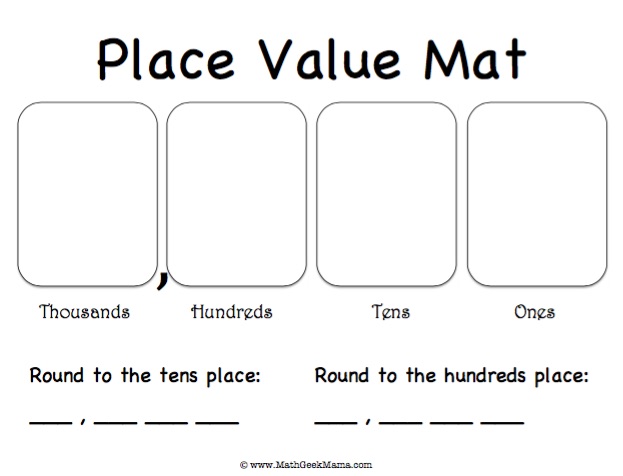
Place Value Mat

Place Value (with rounding)
  • one deck of cards with tens and face cards removed, use ACE as zero
  • 2+ players
  •  concepts: place value, rounding
  • How to play

Many more Math CARD Games here:


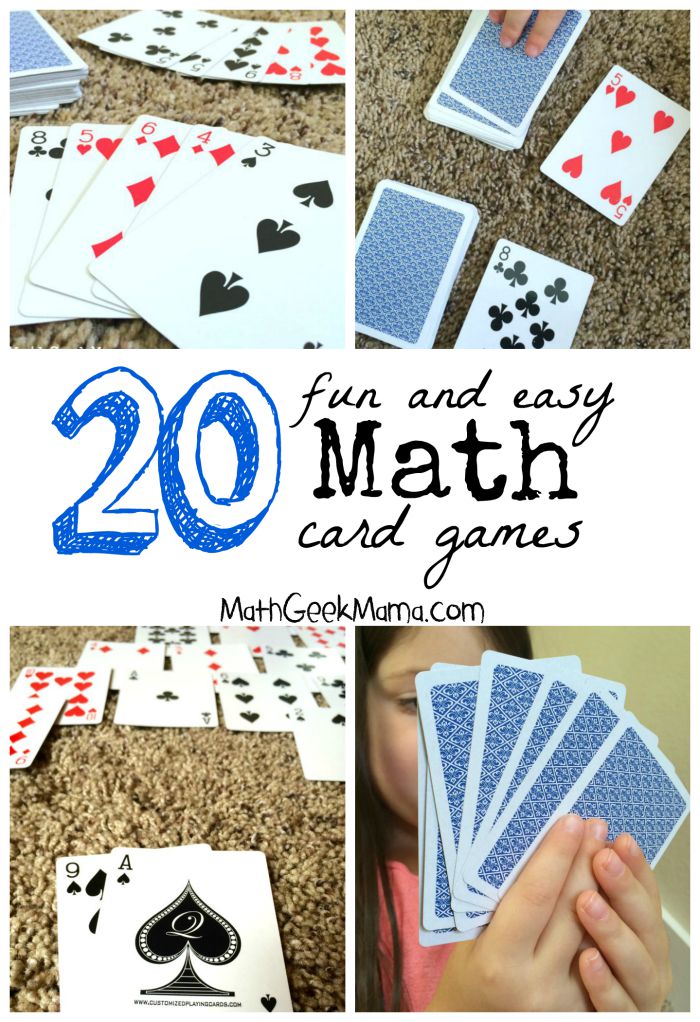
A great collection of fun math card games! These are easy, and in most cases all you need is a deck of cards!


Monday, 13 April 2015

KABOOM - Great Learning Game for Classrooms

I just found this game online and am obsessed! I can't wait to create a few versions of this activity for my classes!

WHY?


1. It is highly engaging!
2. It lasts for as long as you need it to!
3. It can accommodate nearly ANY content area/targeted skill!
4. It is quick to prep!
5. It costs next to nothing to make!


You need sticks, a cup/holder, and to determine which subject area you want to focus on.

For example - basic math facts:


Or maybe you need to glue on some items:


or labels/tags:


You can do this for vocab, definitions, math equations, sight words, rounding, parts of speech, synonyms, antonyms, story elements, the options are endless!


Once you decide and create - here is how to play...


1.  First student pulls out a popsicle stick.
2.  The student identifies the "answer" or "correct response."  If their answer is correct (determined by either a reference sheet or their peers) they get to keep the popsicle stick.  If they answer it incorrectly, the stick must go back in the cup.
3.  The students continue around the circle, selecting one popsicle stick at a time and answering their question.
4.  Any student who pulls a KABOOM! stick has to place all of the popsicle sticks they have accumulated back into the cup, leaving them with zero.  (It may sound harsh, but it happens OFTEN, so all students will at some point get "Kaboomed!"
5.  The game NEVER ENDS because eventually someone will get a Kaboom! and their popsicle sticks will go back into the cup to keep the game going.
 
Source: http://www.starrspangledplanner.com/2015/03/kaboom-possibly-best-center-game-ever.html

Wednesday, 28 January 2015

POST-IT STICKY NOTE DESIGNS - Math Lessons

I will be using this with my Grade 3/4s when we do perimeter and patterns. True, it is a lot of "paper waste" but I think this type of hands on learning is perfect for my class. And I can def. reuse the stickies after =)


Have you used post-it notes for a creative math lesson yet?! (See post from 2012 about post-it math art). They're a fantastic tool to introduce the concept of area and reinforce perimeter. For this lesson, students used 25 or less post-it notes. We made a prediction: Do different shapes that have the same area have the same perimeter? Working in groups of 4, students mapped out their design on 1-inch graph paper and figured out the area and perimeter of their shape. Then, they found a blank wall to construct it! Click here for more math/art projects!


SOURCE

Wednesday, 1 October 2014

Making Ten


Have students work in pairs. Each student has ten cubes of one color and a blank copy of the chart. Each pair trades one color cube with partner and colors in our chart to match. Fantastic to reach all learners: oral, visual, kinethetic, tactile.

Source: http://owl.li/C2Jzr

Wednesday, 24 September 2014

Leaf Learning


As the leaves change colour and begun to fall, why not use nature in the classroom?


Collect and graph different colours and styles of leaves, use them for art, math, science....


Here are some awesome ideas from E is for Explore Blog


Wednesday, 28 May 2014

But, I hate math....

I hear it all the time... students who don't like math.. the correlation between what they like and what they do well in doesn't require extensive research, it is clear... so what impacts students' attitudes towards Math? I found a great article on that...

Factors Influencing Students' Attitudes Towards Math.... This is some great research and an excellent read. My daughter struggles with math in part because she doesn't enjoy it. I am seeking ways to help change that, but this research really helps put the attitudes of "math haters" in perspective.

You need not look far to sense that our current education system is in a state of upheaval. Proponents of Common Core Standards, Alberta’s Curriculum Redesign and the new BC Ed Plan have all placed mathematics in the limelight of educational reform. Addressing the development of negatives attitudes and confidence in mathematics is likely one of the biggest concerns in education today and there is certainly good reason for such concern. The National Assessment of Educational Progress (NAEP) revealed a decrease in the percentage of students who indicated they like math from 1992 to 2000. Likewise, a survey by Olson (1998) revealed that one-third of students reported that they did not enjoy mathematics. With a rising resentment towards the subject, economists fear the work force will be impacted after research revealed that negative attitudes can decrease the tendency of individuals to consider careers in mathematics-related fields (Haladyna, Shaughnessy, & Shaughnessy, 1983; Maple & Stage, 1991; Trusty, 2002). In fact, further studies have shown that students’ attitudes toward mathematics were the strongest predictor of their participation in advanced mathematics courses (Ercikan, Mccreith, & Lapointe, 2005). In the field of mathematics education, this is nothing new. Educators as early as the 1960’s have held the belief that attitude plays a fundamental role in learning and achievement in mathematics (Neal, 1969) and while recent programs in BC and Alberta have identified the steps needed to generate a shift in attitude there is limited literature that summarizes the research about the causes of negative attitudes.

Read more at original source

Saturday, 29 March 2014

Bucket Covers for art centres

You could use these for a number of centres: art, math, literacy, table groups, endless possibilities..


Love this idea of using buckets for an art, math or literacy center... http://owl.li/uUdyE

Tuesday, 25 March 2014

Create a Zoo - Science/Math Collaboration Assignment


Collaboration Project (math and science)
Students collaborate and create a giant zoo! First, tape sheets of grid paper together (cut off the white borders). Next, cut out various irregular shapes off the giant grid for the students (see image). Give each student a piece from the grid. Their mission is to figure out the area and perimeter of their land for their exhibit. They choose an animal and plot out important aspects of its habitat. Does their animal live in the arctic, forest, grasslands, or rainforest. Students think about what colors to use to correctly match their animal's habitat. They must make their animal feel at home in its exhibit. Does their animal play in the water, hide in a cave, or roll around in the mud? They add details to the exhibit. Then, they find an image of their animal online and glue it into the habitat they made. When all of the students are finished, they work together and create a zoo! They problem solve where each animal should go. Should the rhinos be near the elephants? They, glue their designs on an oversized sheet of butcher paper. Then, they add paths, signs, and fences.


Thursday, 20 March 2014

Thursday, 13 March 2014

Fraction Games

FREE Fraction Treasure Hunt (reducing, improper to mixed, fraction to decimal)

Teachers Pay Teachers have a lot of neat (and free or affordable) lesson ides they share, this one is a neat one for fractions.

[Source]

Tuesday, 11 March 2014

Paper Plate Clocks

Making Elapsed Time Fun! - The Organized Classroom Blog

I love this idea for learning to tell time. I know it is always a challenge for kids to learn to read clocks, but this is a cool way to help.

SOURCE

Wednesday, 26 February 2014

Transformation Aquarium - Math fun


Love this. My daughter is doing this in school right now (though she is in French Immersion so the terms are en francais) so we just did some demonstrations of these different transformations.

Thursday, 16 January 2014

Real Life Math Projects.

I love "real life math" lessons. There is a facebook meme going around that talks about how school never taught you to balance a cheque book, pay bills, interest on credit cards, etc. etc. but they were so glad they knew Pythagoras theorem. 

Funny, but comes from truth. I think 'real life math' helps students relate more and be more engaged in going through the process. Here are a few examples from Raki's Rad Resources, another great edu-blog I follow. Though most of her resources are for sale on 'TPT' if you don't want to buy them, they are still awesome starting points to create your own.

I have done shopping projects with budgets to teach tax and shopping and the kids loved it.... 


Grade 2 and 3 students completed a Holiday Shopping Project.  They used websites like www.amazon.com to do mock holiday shopping.  Each student was assigned $100 and chose 3 different presents to purchase.  They then practiced rounding, addition and subtraction while putting together their project sheet. 
Holiday Shopping project - real life application of math skills


One student decided to spend half of his money on a video game for his brother because “he’ll share it  with me!”  It was fun to watch him figure out how to get presents for the rest of his family with the money he had left!

Grade 5 and 6 students completed a Balanced Checkbook Project.  The students were randomly assigned to a job card, which dictated their salary and bills.  Students had to take their annual salary and figure out how much money they would have to work with each month.  Then, they had to balance their checkbook by paying their bills and making a grocery list and estimating a grocery budget.  Students also had the option of buying luxury items and even had a “surprise” – some good and some bad.