Opinions expressed on this blog are my own and do not represent any other organization or affiliation I may have.
Showing posts with label middle school. Show all posts

Monday, 13 April 2015

KABOOM - Great Learning Game for Classrooms

I just found this game online and am obsessed! I can't wait to create a few versions of this activity for my classes!

WHY?


1. It is highly engaging!
2. It lasts for as long as you need it to!
3. It can accommodate nearly ANY content area/targeted skill!
4. It is quick to prep!
5. It costs next to nothing to make!


You need sticks, a cup/holder, and to determine which subject area you want to focus on.

For example - basic math facts:


Or maybe you need to glue on some items:


or labels/tags:


You can do this for vocab, definitions, math equations, sight words, rounding, parts of speech, synonyms, antonyms, story elements, the options are endless!


Once you decide and create - here is how to play...


1.  First student pulls out a popsicle stick.
2.  The student identifies the "answer" or "correct response."  If their answer is correct (determined by either a reference sheet or their peers) they get to keep the popsicle stick.  If they answer it incorrectly, the stick must go back in the cup.
3.  The students continue around the circle, selecting one popsicle stick at a time and answering their question.
4.  Any student who pulls a KABOOM! stick has to place all of the popsicle sticks they have accumulated back into the cup, leaving them with zero.  (It may sound harsh, but it happens OFTEN, so all students will at some point get "Kaboomed!"
5.  The game NEVER ENDS because eventually someone will get a Kaboom! and their popsicle sticks will go back into the cup to keep the game going.
 
Source: http://www.starrspangledplanner.com/2015/03/kaboom-possibly-best-center-game-ever.html

Sunday, 23 November 2014

Thanksgiving Food Lab

American Thanksgiving is upon us and usually I celebrate with turkey dinner (my husband is American)

Here is a cool food lab from We Are Teachers

Thanksgiving-Food-Lab
Don't just eat your food, play with it! Below are six Thanksgiving food experiments that promote exploration and investigation in the classroom!

Bending-Turkey-Bones


Bending Turkey Bones
Wash the bones left over from your Thanksgiving dinner. Can you bend or break the bones? No! Get two jars, fill one jar with vinegar and the other with water. Put bones in each jar and label the jars: water and vinegar. Let the turkey bones sit for at least one week. Then, rinse them off and see if the bones will bend! The bones that were in vinegar bend because the calcium carbonate in the bones reacted with the vinegar. This experiment shows how bones need calcium to stay strong so they don't break easily (or bend). We don't want bendy bones!

Sweet-Potato-Investigation


Sweet Potato Investigation
Watch a potato sprout right before your eyes, creating a sweet potato jungle! For your experiment, look for a sweet potato that has buds. Next, poke four toothpicks into the sides of the sweet potato (spaced out evenly). Put the sweet potato into a clean jar, resting the toothpicks on the jar's rim. Fill the jar with water. The bottom half of the potato should be submerged. Place the jar in a sunny spot, change the water once a week and watch your potato grow! To get your plant to grow bushier, trim stems to 12 inches long.

Cranberry-Science


Cranberry Science
Cranberry Pockets - Do cranberries sink or float? Give each child a Styrofoam cup with water and a cranberry. Have them write their own hypothesis. What happened? Talk about cranberry bogs and harvesting (click here). Then, cut the cranberry in half, so kids can see the inside of it. Cranberries have four air pockets inside of them, which makes them float!
Dancing Dried Cranberries - Explore the three states of matter by making cranberries dance! Toss dried cranberries into a glass of Sprite and watch them bob up and down. The bubbles (carbon dioxide gas) in the soda stick to the rough edges of the dried cranberry. The bubbles bring them up to the top of the glass. Then they pop and release the CO2 into the air, making the dried cranberries fall back down. 
Spy Juice - Students become spies and write secret messages to one another using homemade cranberry juice! Visit the Kitchen Pantry Scientist to learn how to concoct the juice and unveil your top secret writing!

Corn-Cob-Lab


Corn Cob Lab

Popping - Students will be amazed when they create a cob of popcorn! Place a dried corn on the cob in a brown paper lunch bag. Fold over the bag two times to keep the kernels contained. Microwave for 2 1/2 minutes or until the popcorn has stopped popping. Eat it as a classroom treat or use it for a science experiment! Place the popped cob outside and watch as different animal species come by and eat off of the ear of corn. Have the students record the different types of animals in their science notebook and have a lesson on biodiversity. What animals live within your habitat? How are they all connected in your ecosystem? Sprouting - Each kernel on an ear of corn is a seed. By placing a whole ear of corn in water, you can grow a corn cob garden! Instructions: Place a husk free, colorful, dry ear of Indian Corn in a shallow container of water. The corn should only be covered a little more than halfway with water. Place your container in a sunny spot. When the water evaporates, add more and make sure the corn remains submerged in the water. After five days, change the water. Make sure that the side you had up remains up after you change the water. The wet side of the corn is the side you place back in the water and keep submerged. Watch it grow, after a week you will start to see small sprouts or shoots.

Butter-and-Matter


Butter Exploration
Investigate the 3 states of matter by shaking up cream to create butter! Pour one cup of heavy whipping cream in a container with a lid. Once poured, the container should be no more than halfway full (half cream / half air). Shake your liquid and gas to make butter! As you shake, open up your container and check out each stage as your liquid and gas suddenly create a whipped solid: butter! When your butter is ready, refrigerate it. It will become a bit harder. Note: 1 cup of cream will create about 4 Tbsp. of butter). Add some salt to your butter to give it more flavor!

Whipped-Cream-vs-Butter


Whipped Test: Whipping Versus Shaking
Top your Thanksgiving Food Lab off with a sweet ending! Using the same ingredients, heavy whipping cream and air, can you create a different substance? Using a hand mixer, whip 1 cup of cream until you get stiff peaks. Add a little sugar if you want sweet cream. Have the students compare and contrast the butter and whip cream they created. Compare the volume, texture and taste of each food item. Students can draw and label the states of matter for all of the ingredients they used and describe the process for each in writing.

Erin Bittman is a second/third-grade student teacher in a multi-grade classroom at a German Magnet School. She attends the University of Cincinnati. Check out her blog E is for Explore!


SOURCE: http://www.weareteachers.com/blogs/post/2014/11/13/thanksgiving-food-lab

Sunday, 1 June 2014

Passions Projects: DaVinci Day

In the middle school I work in, we do an annual Renaissance Fair for the grade eights each year. They get to rotate through stations to learn a bit on various areas of Renaissance, then choose a "passion" or are to explore. They guide their own journey, learning and creating to share at the fair. This link popped up in my twitter feed and I really like the idea and thought I'd share it here. See more here


DaVinci Day provides an opportunity for students to pursue, research, and share  an area of interest, passion, or curiosity. Providing a time and space to do this type of work in school allows students to begin to see the connections between seemingly isolated academic content and skills, and the real world they will face and influence. When the school experience can be viewed with the perspective of how it will help in the pursuit of their own goals and curiosities, students become more engaged, and education becomes much more relevant. Finding and honing one’s own strengths and talents, assisted by the accumulation of knowledge and skills,  paves the way to fulfillment as well as success. 


Basic Requirements:
1. You must COMPLETE a DaVinci Day Project for the year. 
2. Your project must answer a question that you pose.
3. Your question must be complex and detailed.
4. You must share and "publish" your findings.


See more here

Thursday, 29 May 2014

Beachy Flip-Flop Art

Absolutely love this one!  Art and the Ocean/Flip Flops with Anchor/elementary art(art teacher: v. giannetto) bye bye flip flops, hello backpacks?  display

Almost summer... so many awesome sunny art projects on pinterest right now!

Bring on the summer...From exhibit "My Toes at the Beach"  by Emily9304

You could easily tie this in to a writing assignment also... ah... summer days soon....


Sunday, 25 May 2014

Window Flower Box Craft

Window Boxes- cute idea for the kids- mother's day card for grandma?

What a fun way to decorate a wall or area lacking windows... would make a great art project for Spring or parents day.


Source

Saturday, 24 May 2014

Benefits of Art Integration in Education


One of our middle schools will be a school of fine arts in the Fall  and I am very interested in the concept. In a time where arts is often first on the chopping block, the focus on fine arts, rather than the cutting of it, is a welcomed idea.

I came across this article on research-based approaches to art integration in middle school through a program called 'artful thinking'

I wanted to share some of the article here as it shows some clear evidence on the benefits of art integration in education in some obvious and less obvious areas of learning and development.

Arts integration has been shown by several rigorous studies to increase student engagement and achievement among youth from both low and high socioeconomic backgrounds (Catterall, Dumais, & Hampden-Thompson, 2012; Upitis & Smithrim, 2003, cited in Upitis 2011; Walker, McFadden, Tabone, & Finkelstein, 2011). Arts integration was introduced at Wiley H. Bates Middle School, in Annapolis, Maryland, as part of their school improvement plan in 2008 after the district applied for and was awarded a four-year grant under the Arts in Education Model Development and Dissemination (AEMDD) Grant Program.
Since arts integration was first implemented at Bates, the percentage of students achieving or surpassing standards for reading has grown from 73 percent in 2009 to 81 percent in 2012, and from 62 percent to 77 percent for math during the same period, while disciplinary problems decreased 23 percent from 2009 to 2011.

Artful Thinking

Artful Thinking is a program developed by Harvard's Project Zero in collaboration with the Traverse City Area Public Schools in Michigan. It is an approach to teaching creative thinking that uses six routines to explore artistic works and subjects across the curriculum. These routines contain strategies to deepen art experiences.
  1. Reasoning: Asking, "What makes you say that?" to prompt students to cite evidence to support claims
  2. Perspective-taking: Asking, "What does the character (or author) perceive, know, or care about?" to understand diverse perspectives and ways of approaching problems
  3. Questioning and investigating: Brainstorming questions and using prompts to spark observations and inquiry (e.g., How? What? When? Why? What if? and "I see," "I think," "I wonder")
  4. Observing and describing: Describing and elaborating upon what you see and/or hear (e.g., imagining the artwork as the beginning, middle, or ending of a story, and/or describing formal qualities of a work of art)
  5. Comparing and connecting new ideas to prior knowledge: Asking questions to prompt core ideas and connecting, extending, and/or challenging core ideas
  6. Finding complexity: In order to uncover multiple dimensions and layers, asking questions such as, "How is it complicated?" "What are the different layers and pieces?" "What are its parts and purposes?" "What insights do you have about the topic?"
These routines are fundamental to critical thinking. In a meta-analysis of studies investigating methods of teaching critical thinking, Abrami et al. (2008) cite a broad definition of critical thinking as "purposeful, self-regulatory judgment, which results in interpretation, analysis, evaluation, and inference, as well as explanation of the evidential, conceptual, methodological, criteriological, or contextual considerations upon which that judgment is based." The meta-analysis found that the most effective way to teach critical thinking was by teaching a separate thread of general critical-thinking principles, and then involving students in subject-specific application of these critical-thinking principles. In accordance with this research(Abrami et al., 2008), Artful Thinking explicitly defines several habits of thought that are fundamental to critical thinking and then engages students in applying those habits within specific subject areas.


Wednesday, 7 May 2014

Article: The Harder They Fall: Research shows that high status kids go after each other more than they go after misfits.

The Harder They Fall

New research shows that high-status kids go after each other more than they go after misfits. The targets say they suffer more, too.

popular girls.

Who are the kids who get picked on by other kids—and who suffer most as a result? We are used to worrying about the socially isolated misfits, the tweens and teens who are far down in the pecking order and can’t really defend themselves. We should still worry about those kids, especially if they’re disabled, or gay at a school where that’s not accepted. But they are not the only targets of teenage cruelty. The surprising finding in a new study is that it’s kids with social clout—the popular kids—who report the most distress when they say they’re victimized by their peers.


I find this interesting. When I was in jr. high school, it was the "outsiders" or the "loners" who were victimized and picked on most. I know this, I was one of them. But nowadays, as a teacher and as a mother of a tween girl, I have noticed that it is very much the "popular crowd" who bully each other, gossip and pick on one another. Perhaps this is about power or control of their group? or being jealous of the threat from someone in their group to have the power? I don't know, but this article is interesting to me as my daughter moves on to middle school in September and as I continue to teach middle school and observe the behaviour of my students.

Wednesday, 16 April 2014

Novel Reading: Post-It Note Tumblr Class activity


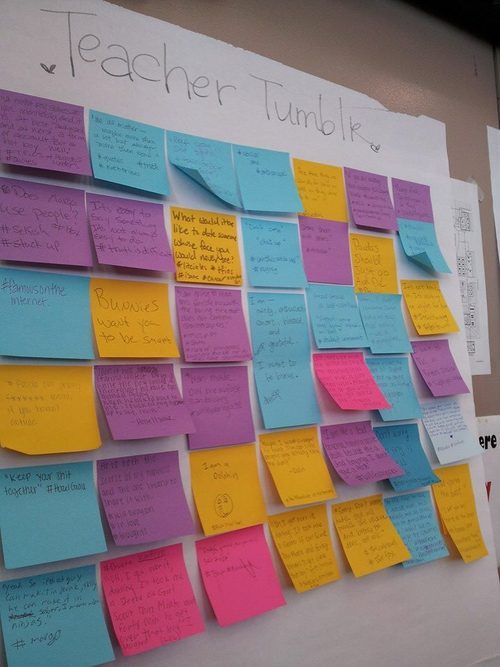
imageimageimage  I absolutely LOVE this activity. I have tried similar strategies, but this teacher describes in detail the process and outcome - I love it!

In this class, students read the John Green novel of their choice.  We didn’t attempt to balance the groups. Because it was enrichment, we really wanted students to have choice and to read the novels that spoke to them.  We had about 35 students read The Fault in Our Stars.  We had just 6 students readWill Grayson, Will Grayson.  The rest of the students were scattered about equally between Paper Towns, Looking for Alaska, and An Abundance of Katherines.    
Our Goals
1) Students read independently. 2) Students come prepared to engage in text-based discussions. 3) Students write analytically about the text.
The strategy we introduced on the first day was a way of cataloging their Post-It notes during their reading.  We knew students would find a great number of passages in their reading that they found meaningful, but I wanted to push them to think more about why they passages they marked were significant.  (In previous Breakfast Club sessions, we’d found students didn’t want to annotate IN THEIR BOOKS.  For many of our kids, this was the first new book they’d ever owned and they were reluctant to write in them!)
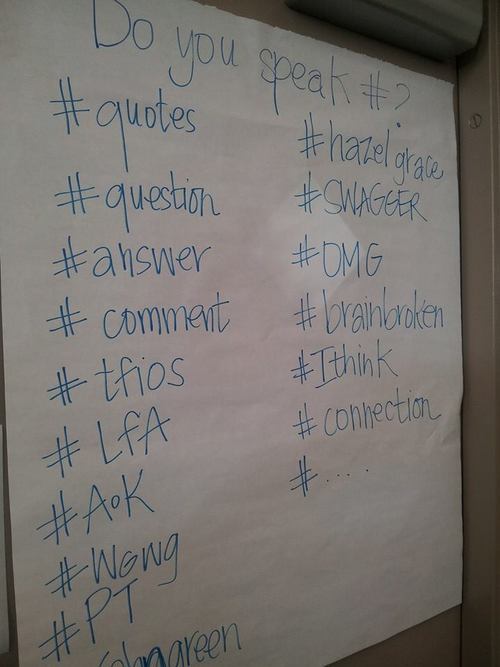
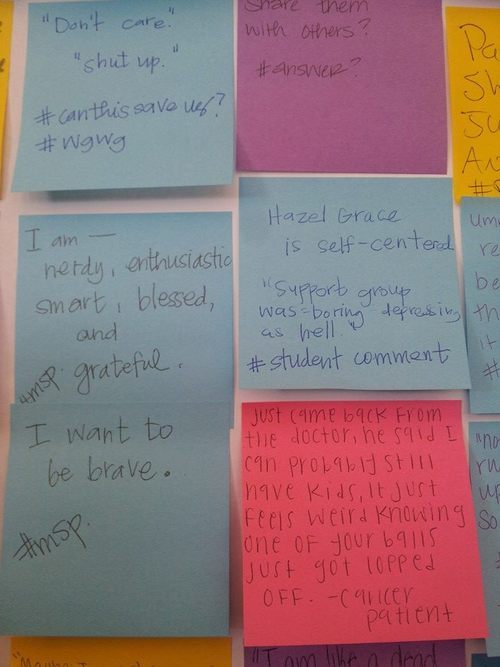
Our students loved to highlight their favorite passages by copying them onto Post-Its.  We asked them to tag those significant passages #quotes.  We also asked them to consider other hashtags, like #characterization, #plot, and #figlang.  Students were also encouraged to write their questions and reactions on Post-Its and to tag them accordingly.  From the first week, students were excited.
Every student had a large piece of construction paper where they were able to arrange their Post-Its each week.  We used them for first check ins.  Students would read the “Tumblrs” of their group mates.  We encouraged them to “like” and “comment” on each other’s Post-Its.  They were also able to “reblog” other student’s thoughts if they wanted to add to them.  (We made sure they gave their classmates credit.)  We also had a “Teacher Tumblr”. We used this to keep track of comments we heard when listening to the group discussions and questions that came up for us.  We also invited students to add questions and comments, which they did.  With enthusiasm.
Integrating Evidence Meaningfully in Discussion and Writing
One way we used the Post-It Notes to help students get ready to speak and write about their texts was to ask them to pull out those Post-Its on which they’d written significant lines or passages from the text.  We knew our students could read and opine about the action and the characters, but they struggled to present substantial evidence to support their assertions.  Their first instincts were not to begin with the text and work out from there.  Often we’d receive writing assignments that included NO evidence from the text.  In revision, students would go back to the text looking for three or four quotes to shove into the already-written essay.  Not a lot of commentary there.  
So we asked students to pull out those quotes, and then on new Post-Its, we asked them to write a sentence or two of context.  What’s happening in the quote or passage?  What would a reader need to know?  #context Now, get another Post-It.  What does it mean?  What is the writer doing? Why is it significant to the greater meaning of the text? #commentary
Students began to understand the ways they could be commenting on the text, and they began making these notes independently as they were reading.  
It was powerful because when we asked students to come together and discuss questions about their text, they were ready to talk.  They had things to say.  They went to their Post-It Notes and some of the processing had already begun.  
The flexibility and mobility of the Post-Its also helped our students to track the development of characters and themes across the text.  They could group patterns together, they could look at statements characters made early in the text side by side with statements they’d made later in the text. 
We introduced “The Author Says, I Say” to help students see how to seamlessly integrate evidence into their own writing. 
On the last day, when we gave the students an unannounced on-demand writing assignment, you could hear a pin drop in the room.  Students who used to struggle to write a sentence had something to say.  In all the weeks leading up to the last class, we never told the students they would be expected to write, but when we asked them to, they were ready, because they had already had multiple opportunities to process their thinking, and discuss and write about the text.
Our students reported feeling more confident as readers and writers and during the debrief, they talked about ways they could use the strategies in other classes.


Source

Friday, 28 February 2014

Animal Adaptations

I have done a similar activity before. Students had to create an animal that had adaptations suitable for the biome they chose. This is a neat version of this where students take two animals and create a venn diagam to morph the two together, including their name and features.

Friday, 14 February 2014

Sunday, 15 December 2013

Home Ec: Currently Cooking: Rustic Apple tarts and fried rice

Last week we made 'Rustic Apple Tarts' with our Grade 8s. They make their own dough on day one and then day two they fill their tarts. I have to say, VERY delicious!!!


Our grade 6/7s made fried rice. Day one was chopping veggies and preparing while day two was frying everything up - pretty delicious! I think if we had the budget to add chicken or a meat, it would have been even better!


As part of the 'Re Think Your Drink' and 'SIP Smart' lessons, we make healthy smoothies each term so students can taste how even avocado, kale, spinach, berries and rice milk can taste delicious!


Speaking of smoothies, this article about smoothies was pretty interesting... I think people forget that even though fruit is providing natural sugars, it is still sugar (albeit better than added sugars) moderation is key.

This week we are finishing up our holiday baking (sugar cookies and shortbread) before Winter Break. January is term three... I can't believe how quickly these Home Ec terms go by! 8 or so weeks! Crazy! And they are only 40 minute blocks each day!

Tuesday, 15 October 2013

Home Ec: Checking In #homeecteacher

Wow, October is half way over, I feel like I am finally getting my head wrapped around the ins and outs or teaching Home Ec again! I meant to post more sooner, but just haven't had the time... but I want to post more! As a new home ec teacher, I am learning so much and want to share it with others who may find themselves teaching home ec, but also to seek ideas from those of you more experienced home ec teachers =)

My job share partner teachers M-W and typically does the recipe and demo with the students along with the lessons. My Thurs and Fri is typically cooking/lab days and on off weeks continuation of the lessons.

We are doing just foods/cooking, not sewing, which I have taught in the past (Sock Monkeys for 6/7s, PJ pants for 8s)

I wanted to share some of the labs we have made. I didn't get photos of the cheese scones, quesadilla, fruit tarts or berry muffins, however, I do have some of our other labs....


Grade 6/7s did fruit crisps... messy but delicious!

Grade 8s did pizza pockets. Dough was Day 1, Stuffing was Day 2

Grade 6/7s made personal/co-operative pizzas

My face says it all... this was my FIRST lab day, It felt so great to see all the students enjoying their muffins!

Banana Chocolate Chip Muffins - these were so yummy!
So, although things are VERY busy, they are going very well! I am really enjoying Home Ec and as first term comes to an end in a couple weeks, I feel like second term will be a blast now that I am used to my new position!!

Saturday, 28 September 2013

Home Ec: New Posts Coming

So as I mentioned in a previous post, I am teaching Home Ec this year to grades 6/7 and grade 8. I am only there two times a week as I job share, and half the day is Student Services and half the day is Home Ec.

That being said, the two days I am there are mostly "LAB DAYS" which means the students are all cooking.

I am not much of a baker or cook at home, my husband does a lot of that, but one of the keys to Home Ec Labs, as I am learning, is classroom management, supervision, organization and time management.

Maybe I am not the best cook, but those things I am very skilled at.

This week was my first lab with the kids. Grade 6/7s did twice baked stuffed potatoes and Grade 8s did a two day lab making banana-chocolate chip muffins.

I am excited to announce that things went very smoothly. I had the youth worker come in for an extra set of hands and eyes, my job share partner was very organized and had everything ready to go and everything turned out delicious and on time!

I am starting to connect with other Home Ec teachers through social media, especially twitter, and feel more creative in the things we can plan for term two.

What is awesome about teaching "EXPO" or Explorations, is that I get to connect with every student in the school by the end of the year and it is something most of them look forward to doing.

We get 8 weeks with each group and they are 40 minute blocks five days a week.

Anyhow, I plan to start posting occasional "HOME EC" features on my blog so stay tuned!


Friday, 13 September 2013

Roll a Story

 
This would be a fun activity for a 'Writer's Workshop' session..... As a TTOC (teacher teacher on call)
 I always have dice in my Bag of Tricks. What a fun way to inclkude literacy in the classroom.


http://pinterest.com/pin/468374429966809414/

Thursday, 13 June 2013

How to Talk to Little Girls...

This in an excerpt from an article written by Lisa Bloom and reposted on a blog:

Little Maya was all curly brown hair, doe-like dark eyes, and adorable in her shiny pink nightgown. I wanted to squeal, “Maya, you’re so cute! Look at you! Turn around and model that pretty ruffled gown, you gorgeous thing!”

But I didn’t. I squelched myself. As I always bite my tongue when I meet little girls, restraining myself from my first impulse, which is to tell them how darn cute/ pretty/ beautiful/ well-dressed/ well-manicured/ well-coiffed they are.

What’s wrong with that? It’s our culture’s standard talking-to-little-girls icebreaker, isn’t it? And why not give them a sincere compliment to boost their self-esteem? Because they are so darling I just want to burst when I meet them, honestly.

Hold that thought for just a moment.

This week ABC news reported that nearly half of all three- to six-year-old girls worry about being fat. In my book, Think: Straight Talk for Women to Stay Smart in a Dumbed-Down World, I reveal that fifteen to eighteen percent of girls under twelve now wear mascara, eyeliner and lipstick regularly; eating disorders are up and self-esteem is down; and twenty-five percent of young American women would rather win America’s next top model than the Nobel Peace Prize. Even bright, successful college women say they’d rather be hot than smart. A Miami mom just died from cosmetic surgery, leaving behind two teenagers. This keeps happening, and it breaks my heart.

Teaching girls that their appearance is the first thing you notice tells them that looks are more important than anything. It sets them up for dieting at age 5 and foundation at age 11 and boob jobs at 17 and Botox at 23. As our cultural imperative for girls to be hot 24/7 has become the new normal, American women have become increasingly unhappy. What’s missing? A life of meaning, a life of ideas and reading books and being valued for our thoughts and accomplishments.
------
So, one tiny bit of opposition to a culture that sends all the wrong messages to our girls. One tiny nudge towards valuing female brains. One brief moment of intentional role modeling. Will my few minutes with Maya change our multibillion dollar beauty industry, reality shows that demean women, our celebrity-manic culture? No. But I did change Maya’s perspective for at least that evening.

Try this the next time you meet a little girl. She may be surprised and unsure at first, because few ask her about her mind, but be patient and stick with it. Ask her what she’s reading. What does she like and dislike, and why? There are no wrong answers. You’re just generating an intelligent conversation that respects her brain. For older girls, ask her about current events issues: pollution, wars, school budgets slashed. What bothers her out there in the world? How would she fix it if she had a magic wand? You may get some intriguing answers. Tell her about your ideas and accomplishments and your favorite books. Model for her what a thinking woman says and does.

And let me know the response you get at www.Twitter.com/lisabloom.

Here’s to changing the world, one little girl at a time.

Read entire post here: http://latinafatale.com/2011/07/21/how-to-talk-to-little-girls/